Robert Anton Wilson and Robert Shea. Blog, Internet resources, online reading groups, articles and interviews, Illuminatus! info.

Tuesday, June 30, 2020

Nature's God, Chapter Nine, Part One


Week Nine: Chapter Nine “Cherry Valley” (Part 1) pg. 159-169 Hilaritas edition

By Gregory Arnott
Special guest blogger

This chapter sees the climax of Sigismundo’s character arc in Nature’s God but before we get to that we’ve got to wade through the gore and confusion that was Cherry Valley.

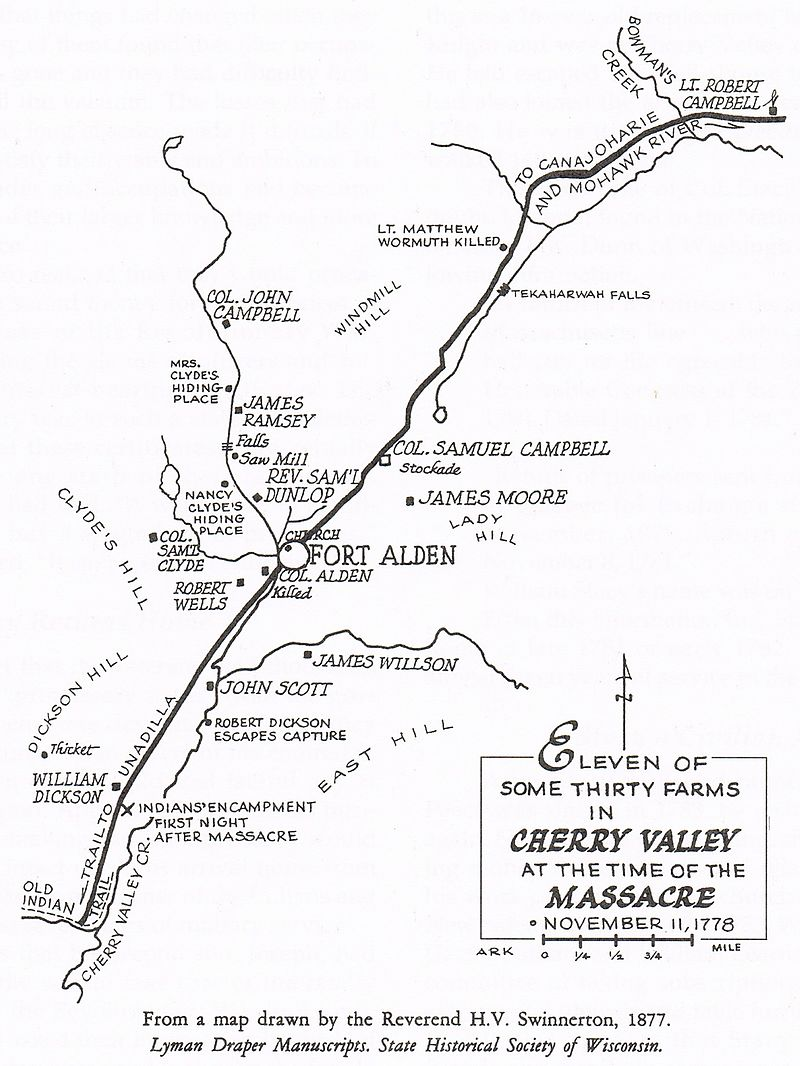
Cherry Valley should stand, not as a memorial to patriotism, but rather as a reminder of mankind’s inhumanity towards man. Because this chapter deals so much with Miskasquamish, RAW’s main American Indian character, it is worth noting that historians are conflicted on how much the loyalists had to do with the civilian massacre at Cherry Valley on November 11, 1778.

The troop that attacked Cherry Valley consisted of loyalists, British soldiers, members of the Seneca, and Mohawk tribes of the Iroquois Nation under the command of loyalist Walter Butler. According to Butler he had little to no control over the indigenous people who were with his group. Historians seem to agree that it was the Seneca members of the raiding party who turned on the civilians. The Seneca’s anger was caused by the destruction and burning of their settlements by American settlers...an eye for an eye. Butler’s command was undermined by conflicts with Joseph Brant, leader of the Mohawk tribesmen. The division between these two leaders allowed for the massacre of 30 civilians, along with 14 soldiers, and Colonel Alden, the American commander of Cherry Valley. Curiously, one survivor of Cherry Valley, a Lieutenant Colonel Stacy says that he was about to be killed but appealed to Brant, indicating that he was a freemason, and Brant had his life spared. Brant would also capture 70 people from the survivors of the initial attack.

The Colonial forces had been warned up to three days before the raid by Oneida allies; however, the commanding officer Colonel Ichabod Alden didn’t take the reports seriously, keeping his command outside of the central fort. That is probably why his name is on the list of casualties of the initial raid. Indeed, the British and Indigenous forces didn’t have the firepower to breach the fort but swept around it, attacking the nearby settlements.

Cherry Valley did more than drive Colonel Muadhen, who thought he’d seen it all, into Bible-babbling catatonia. The colonists were horrified at the massacre and General Washington commissioned the Sullivan Expedition that spent the next year trying to drive the Iroquois completely out of New York. Eighty villages were attacked and razed over the next year by Colonial forces as a part of the Frontier War that raged along the Revolution. An eye for an eye. Funny how we’re not even good, as a species really, at proportionate response and some still believe in that dreadful equation.

Sigismundo, a colonist of the Northwest Territory, is having his own conflict with a native resident. Miskasquamish has pushed Sigismundo towards something of a breaking point; it is appropriate that during their tense conversations they sit by sulphurous water. Alchemically, sulphur represents the “heating” of the work...the rising action. Sulphur is also used in Afro-American Hoodoo to cross, jinx, or banish enemies and obstacles. “I hope you know...this means war.”

Their conversation also seems to play with European/Indigenous relations as well. Sigismundo tells Miskasquamish the story of Christ without identifying him and in the terms of Miskasquamish’s cosmology. Contrast this to the historical missionary efforts to forcefully convert the American Indians and erase their cultural understanding of the universe. Sigismundo also insists that he has the right to live in Ohio because he took the time to build his house there and hasn’t acted aggressively to his new neighbors. Right now, there is a small movement to rename the capital Columbus to something more suitable, like Flavortown. Many Ohioans and the folks in the peanut gallery are upset by this “erasure of history.” I wonder how many of them know where place names like Chillicothe, Cuyahoga, or Ohio came from and what they mean. We are left with the question, to whom does the land belong?

If we consider Wilson’s The Trick Top Hat, which to me seems to be a pretty earnest depiction of his version of a utopian United States, Miskasquamish is probably going to be disappointed in his property dispute. Neighborhoods in The Trick Top Hat are regulated thusly: if a neighbor annoys you by living eccentrically, loudly, outside the Homeowners Associations rules, etc. you may lodge a complaint. Government officials will try to talk with the neighbor, see if they can find them a more appropriate neighborhood- usually to one of the LaGrange floating cities where eccentrics are flocking during the novel. However, if the neighbor chooses to remain and they’re not directly affecting the rest of the neighborhood, there’s fuck all anyone can do about it. So, while Miskasquamish is worried about the moral depreciation of his neighborhood with a Reverser present, well...let’s just say “there goes the neighborhood.”

Miskasquamish’s confusion upon seeing the gun makes sense only at the end of this chapter. His naivety is almost offensive during the sequence as surely a man who had travelled so far during the pre-Revolutionary period and Revolution would have encountered firearms. Sigismundo’s display of the weapon also parallels the ultimate outcome of many colonial-native relationships and the Cherry Valley massacre. Sigismundo’s display of superior technology is troublesome to this reader and reflects the history of the Americas all too well. That said, RAW gives Sigismundo a moral “out” by having Miskasquamish note he never directly threatened his body with the gun...if that is much of an out. Miskasquamish takes this away from Sigismundo’s stories about the Builders and his interactions with the Neapolitan; all the Europeans are mad. Considering history, I’m not sure is Miskasquamish is truly “paranoid.”

Parallel to Seamus’ sickness as witnessing the maraschino-hued carnage of Cherry Valley runs the miraculous recovery of Paddy the Dog back on the Babcock Estates. Considering how Seamus saw himself through the eyes of the English, it is darkly appropriate that there is now a character dubbed “Paddy the Dog” trotting around his old stomping groups. Little Ursula has inherited her mother’s gift and while we see no evidence in the first part of the chapter, her nigh-resurrection of Paddy, who might also be a reference to Joyce’s departed Paddy Dignam, might have a sympathetic effect on Muadhen across the pond.

Miskasquamish returns to Sigismundo dressed as a woman; a reference to some native Tribe’s gender nonconformity and reminiscent of the gender swapping tradition found in shamanic traditions such as the Nat Pwe of Thailand. After appearing to Sigismundo, who asks no questions, they proceed to smoke and travel to strange new worlds.

From Eric: “Some witch music for this chapter. https://youtu.be/Nz5DLO8fclA

Monday, June 29, 2020

Monday links


Not a good guy, believe it or not. 

The Nature's God reading group will return soon. 

The Myth of the Kindly General Lee. An Adam Serwer article from 2017, but more relevant than ever.

When I was a young education reporter in Lawton, Oklahoma, I once did a short piece about a contest by students at Robert E. Lee Elementary to write essays on what they admired most about Lee. (Lawton is a military town, so it did make sense to name schools after generals -- my son wen to Eisenhower High, and there is also a MacArthur High.) Most of the kids who won were Black, so we ran a photo of a bunch of Black kids holding up the little Rebel flags they had won. The school closed years ago. 


Much of the "violence" at protests comes from police. There's a lot of this on Twitter.  

Sunday, June 28, 2020

This year's 'Best Novel' Hugo ballot has really good finalists


I'm "attending" this year's all-online World Science Fiction Convention in New Zealand and for the first time in many years I have read all of the novels on the Hugo ballot (I'll vote in as many categories as I can become well informed -- the deadline is July 15.)

The Best Novel finalists -- six novels, all by women -- is a very strong collection of titles. I'd be happy to see an award go to any of my top four; I am particularly hoping the Hugo goes to one of my top two. Here are my rankings:

1. Middlegame, Seanan McGuire.

An utterly absorbing fantasy novel about artificially created twins, a young man very good with words and a young woman good at math and chess. Unusual and complex but very well put together.

2. A Memory Called Empire, Arkady Martine.

Galactic empires are not a new subject, but this novel, by a historian of Byzantium, focuses not on the military but on the cultural hold an empire such as the Roman Empire has on is neighbors. I liked this novel so much I gave myself a name according to its naming system: Eight Apricot.

3. The Ten Thousand Doors of January, Alix Harrow.

Like the McGuire, this has a book within a book, and in fact it's an extended metaphor on the idea of books as gateways into other worlds. A fresh and vivid first novel.

4. Gideon the Ninth, Tamsyn Muir.

Muir is from New Zealand, but this nomination does not seem like home cooking; it's an original and vivid book that earns its nomination. It revives the sword and sorcery genre, although the elements of horror are so vivid you might not notice at first. The ending seemed a bit force and unsatisfying to me.

5. The City in the Middle of the Night, Charlie Jane Anders.

A vivid depiction of an unusual world with excellent aliens. I did not think the narration worked particularly well as a story, and for me it didn't so much end as peter out once a book length had been reached. This just won the Locus Award, however, so many readers disagree.

6. The Light Brigade, Kameron Hurley.

This title, kind of a mash up of The Forever War and Slaughterhouse Five, did not work particularly well for me.

Saturday, June 27, 2020

Lester Grinspoon has died


Dr. Lester Grinspoon, the Harvard psychiatrist who did so much to advance rational discussion of marijuana in the U.S., has died at 92. (If you are new to this blog, I am talking about freedom and rational public policy, not "everybody must get stoned.")

Here is a tribute by the excellent Jacob Sullum. You can also read the tribute by Keith Stroup at NORML. 

Friday, June 26, 2020

Vivaldi's 'Four Seasons'


A Creative Commons recording of The Four Seasons by the Wichita State University Chamber Players. 

Gregory Arnott's excellent Nature's God blog post Monday discusses the history of magick, something I know nothing about, and inspired some great comments. I thought for today's post, I would say something about Antonio Vivaldi's The Four Seasons, mentioned in the chapter Gregory covers. (I had a tough work week, working seven days in a row. On the seventh day, yesterday, I finally read the chapter and then listened to a Trevor Pinnock recording of The Four Seasons.)

As Maria falls asleep, she thinks of the "thirteen Weeks in each of the four Seasons, Vivaldi's Four Seasons music running through her head, and the thirteen at the Last Supper, and the sun, which is One, moving in eternal circle through the 12 Houses, one plus 12 being thirteen..."

I would point out that the structure of Vivaldi's work also fits the "one plus 12 being thirteen" that Maria thinks about. It's a work about the cycle of one year, but it consists of 12 movements, three for each season. (Three movements are the normal structure for a concerto, and The Four Seasons is a collection of four violin concertos.)

The Four Seasons itself has an amazing history. Vivaldi, who died in 1741, was pretty much forgotten for more than 150 years (it's not really likely Maria would have known his music) but eventually The Four Seasons underwent an amazing revival. Wikipedia cites the numbers: "The World's Encyclopedia of Recorded Music in 1952 cites only two recordings of The Four Seasons – by Molinari and Kaufman. By 2011, approximately 1,000 different recorded versions have been made since Campoli's in 1939."

If you have a library card, you can likely to listen to dozens of recordings on the Freegal or Hoopla Digital streaming music services. Or you can listen to the recording by John Harrison and the Wichita State University Chamber Players, released to everyone under a Creative Commons license.


Thursday, June 25, 2020

Thursday links


Antislavery activist Hans Christian Heg, who died in battle fighting the Confederacy.

PQ on "Reading the News Inside Finnegans Wake" 

Scott Armstrong deletes his blog, Slate Star Codex.  I like the New York Times -- I'm a paid subscriber, an effective form of fandom when newspapers need money -- but I hope the relevant editors and reporters change their minds about this. Here is Reason's coverage. Here is Scott Greenfield's take.  There's also an online petition.  (I signed.)

Protesters destroy statue of anti-slavery activist. Not an isolated incident, I see a lot of this stuff on Twitter.

Jim O'Shaughnessy (the RAW fan on Wall Street) makes a donation.

Reasons to cheer up. 

Wednesday, June 24, 2020

Maybe Day Is Coming!

July 23rd 2020

www.maybeday.net

Possibly! Potentially! Probably!


By Bobby Campbell
Special guest blogger

Actually, most definitely, but in keeping with the spirit of the day perhaps there should remain an air of mystery.

I'm happy to say that the virtual organization of a collaborative digital RAW event is coming together quite nicely.

On July 23'rd we're on schedule to release:

NEW TRAJECTORIES  

A digital zine powered by the negative entropy of Maybe Logic.
Featuring art & philosophizing by a cavalcade of RAW exegetes.
Very much a throwback to the old Maybe Quarterly days.
(Also, there's still time to submit, hit me up, RGC777@gmail.com)

Mike Gathers, of rawilsonfans.org, is prepping a microbook on the 8 circuit model.
I just got my first look at it today and it is substantial!

RAW VISIONS 2020

A series of neuro-electrifying video presentations.
I'll be releasing a talk called "LIVING IN A RAW WORLD"
We've got PQ discussing Finnegans Wake and the I-Ching,
Brenton Clutterbuck on Chasing Eris, and I believe we'll also be hearing from Steve Fly, Prop Anon, and maybe more!

Also! Just moments ago I recruited Tom Jackson to moderate a zoom panel conversation with as many of our co-conspirators as possible.

And finally, we've got a mini Maybe Logic Academy reunion already starting to gather over at the Only Maybe Arts Lab:


https://onlymaybe.boardhost.com/

Which will also be the main social venue for the event. A place to cuss and discuss the possibilities of what may or may not be :)))

Monday, June 22, 2020

Try the new audiobook


Want to try the new Cosmic Trigger 2 audiobook before you buy it?

Click the above video from Hilaritas Press to hear Chapter One, narrated by Oliver Senton.

Chapter 8, Nature's God reading group


Week Eight: Chapter Eight “My Lady Greensleeves” pg. 139-147 Hilaritas Press edition

By Gregory Arnott
Special guest blogger

After asking Oz for confirmation, I am confident in saying that the structure of this chapter is taken from Crowley’s Liber Aleph. This is ironic for a chapter dealing explicitly with Maria’s initiation into a Wiccan coven as Oz pointed out that Liber Aleph was written as a series of letters from father to son. (Specifically from Crowley to Charles Stansfeld Jones, better known as Frater Achad, his “magical son.”) The intermittent Latin titles are used throughout Liber Aleph and Robert Anton Wilson uses the same device in Masks of the Illuminati. The biblical phrase for He is like a refiner’s fire also appears prominently in the earlier novel. The tone of this chapter, specifically the ecclesiastic sounding “yea, the…” repetition, is also taken from Crowley’s Holy Texts.

Here is my Google-assisted hack-job translation of the titles, considering the action that happens following each title I believe my unwieldy versions make some sense:

The Hardening of Man
On the Danger of Alternative Love
On the Four Equal Virtues
The Female Formula
The Crazy Love
The Great Works of the Microcosmic Star of Which there is Four
The Secret Horror
The Delicate Powers of Art and Love
Hold, Illegitimate Vigor

The coven that Maria is initiated into is more-or-less an anachronism with the language taken from post-Gardnerian Wicca. Bear with me and for any neo-pagans who might be reading, I’m not trying to be offensive.

The fact that the language is so strongly influenced by Crowley’s writings is appropriate. As Kenneth Grant and other writers have related, during the Twilight of the Magicians, the lingering years of the two great English occultists of the 20th century, namely Aleister Crowley and Austin Osman Spare, an eccentric customs-officer named Gerald Gardner was lurking around in their company.

Gardner, who follows in the grand tradition of magic by being a goddamn liar, claimed that his Wiccan practices were derived from a coven that had kept pre-Christian religion alive. He had mostly made up his practices from stitching together elements of the, now discredited, anthropological studies of Margaret Murray about a supposed witch-cult, Freemasonry, and ceremonial magic. In fact, the three degree ceremonies presented by Gardner for the purpose of Wicca were penned by, wait for it....Aleister Crowley.

Curiously, RAW’s use of terms such as “women’s mysteries” and the “burning times” doesn’t appear to be ironic. I believe this is curious when we consider how much hostility towards some late-twentieth century academic models of femininity RAW displayed in his writings, especially since both of those terms are complete, artless bullshit. The concept of “women’s mysteries” bastardized the study of pre-modern religion and tried to replace the complex mythological development of goddesses such as Demeter, Sekmet, Selene, and Isis into a group of gentle Montessori teachers whose feminist, pre-agricultural utopia was ruined by the arrival of phallic gods. Given that there is nary a drop of historical evidence for these gentle matriarchal societies and that the historical record of how these goddesses were apprised and worshipped is much more ambiguous didn’t stop the believers from trying to rewrite history. (Though Crowley doesn’t spend the time moralizing like later witches, it is worth noting that according to his structure of history the first Aeon was matriarchal and was subsumed by the agricultural-phallic second Aeon. We are now in the third Aeon where the focus is on the development of the complete person, the child, and individual sexual dimorphism seems to be the rule of the day.) Perhaps even more annoying is the use of the idea of “the burning times” which, forgive me, is such a stupid fucking concept my ears bleed anytime I hear someone utter it.

There was no “burning time” that modern covens suffered through and survived underground as they watched legions of innocent believers of the “old religion” burn at the stake. Historical evidence, known as far back as the turn of the twentieth, indicates that pretty much every witch hunt was either a power-play by ruling/ecclesiastic authorities or the result of hysteria. The excellent Swedish film Haxan: Witchcraft Through the Ages presents a compelling and intelligent examination of these phenomena- even better, watch the version with William S. Burroughs narrating.

In conclusion, this chapter is made up, not that big of a revelation in a novel, almost whole cloth from twentieth century notions that couldn’t have existed because ceremonial magic hadn’t come along to create them yet. The notion of the four elements was around at the time but the codification of what those elements mean “spiritually” wasn’t wholly accomplished until a bunch of old Rosicrucians got together to combine the works of Paracelsus, Agrippa, the Qabalah, and Tarot into one system of magic. A study of the Tarot will reveal how many of our romantic notions (for example, that the modern playing deck is derived from the cards smuggled from ancient Egypt) are entirely erroneous. Indeed, before Moina and MacGregor Mathers codified the Qabalah to to the Tarot, building on the work of Eliphas Levi, any use of it for divination or meditation would have been no more sophisticated than basic cartomancy. Even the pentagram, today used as a symbol of neo-paganism, wasn’t imbued with its microcosmic significance until the Golden Dawn came along to create the Lesser Ritual of the Pentagram and their study materials.

Yes, there are examples of the four elements, the four apostles, the four faces of Ezekiel’s angels throughout history, but to say that there was a working system of knowledge, linked with similarly initiated members throughout history is as romantic and ahistorical a notion as the existence of Sigismundo Celine, Old Kyte, and Maria Babcock. And blimey, I haven’t talked about anything that actually happens in the chapter -- I guess that’s a sign that it’s time for me to get to bed before I become any crankier and end up with a crudely fashioned crystal tipped wand through my throat or a mail order athame through the heart.

The stuff about the I Ching is mostly accurate in that Leibniz was obsessed with the similarities between the Hexagrams and his notions of binomial numbers and Calculus, however it would still be almost a century before writers began to connect the I Ching to Western Mysticism. The pioneer of this connection? You guessed it, Aleister Crowley.

From Eric: A soundtrack for our “Study-Group or Coven or whatever this was called” (Nature’s God, pg. 142). https://youtu.be/nwn2zd8ROlQ 

My own musical offering: https://youtu.be/zE4yQxRvWGU


Sunday, June 21, 2020

The 'lost' forward to the new 'lost' RAW book


Adam Gorightly

Discordian historian Adam Gorightly, who deserves a lot of credit for making the impending publication of the new Robert Anton Wilson book, The Starseed Signals: Link Between Worlds possible, has posted a new article shedding more light on the book.

Adam had originally intended to publish the 1970s RAW manuscript at RVP Press.

"However, at some point in this cosmic caper, RVP had a falling out with the RAW Trust, and the book deal fell through — as book deals sometimes do — in the wacky world of publishing," Adam explains.

The bulk of Adam's new post is the original foreword he wrote for that abortive effort, and it sheds a lot of light on the background for the upcoming book:

Starseed Signals was dashed off over a two-week period in early 1975, a burst of energy supplied by the sudden turmoil and controversy surrounding his friendship and collaborations with the infamous Dr. Timothy Leary, who RAW perceived as one of the most brilliant, yet misunderstood minds of not only his generation, but of any.

During this period—as Leary sat caged in prison on trumped up drug charges—he and RAW conceptualized a book project entitled A Periodic Table of Energy, a scientific system of neuro-psychology based on eight evolutionary circuits, or steps, through which humanity progresses, with the latter circuit propelling WoMan to the stars, the ultimate evolution, our union with the infinite and quest for immortality.

Read the whole thing. 


Saturday, June 20, 2020

Listen to Irish radio's 'Ulysses' adaption


I recently learned it is possible to obtain a podcast of Ireland's public broadcasting system radio adaptation of James Joyce's Ulysses.

"The definitive adaptation of the novel is widely considered to be RTÉ's full dramatised production – originally broadcast in 1982 to celebrate the centenary of Joyce's birth, and totaling 29 hours and 45 minutes in duration," says the website for RTÉ.

According to Tom Lennon on Twitter, this is a Ulysses broadcast Robert Anton Wilson "recorded to videotape and revisited often."

Available here and also on many podcasting apps.


Friday, June 19, 2020

Protests, fnords, etc.


By DeviantArt user thsgys via  @Jimthediamond

Above is a photo posted on Twitter by Pipzi Williams (@lordfanny1723) with her haiku:

in the gap between 
the words 'riot' and 'police'
i saw the fnords

You can also read a related essay at the Zen Pagan by Tom Swiss,  which explains fnords and Discordianism and says, "Am I saying that a joke religion is the best way to understand these times? Yes. Yes I am."

Thursday, June 18, 2020

The 'lost' RAW book will be out soon


The view from Rasa's window as he toils on The Starseed Signals. That's Mount Shasta. 


[When I spotted the news about the planned publication of The Starseed Signals: Link Between Worlds, l naturally wanted to know a lot more, so I contacted Rasa and he immediately agreed to take a few questions. While some details about the book apparently won't be revealed until it comes out, i.e. the identity of the writer who agreed to write an introduction, this may answer sombunall of what Robert Anton Wilson fans want to know. For example, it's clear Hilaritas Press is trying to get it out soon, maybe even the next few weeks.

There has been some discussion about the overlap between Cosmic Trigger and The Starseed Signals. On Twitter, Charles Faris, one of the very few people who has read Starseed, wrote, "Happy to say that I’ve read it and it’s freaking awesome. I am beyond excited that it’s going to be published. He goes through the same territory from a completely different perspective. It’s great."

Richard Rasa,  usually known only as Rasa, is listed at Linked In as "metaprogramming director at the Robert Anton Wilson Trust." While Wilson's daughter Christina Pearson is the trustee of the trust, Rasa handles much of the day to day work and serves as the editor at Hilaritas Press, the publishing imprint of the trust. For more on Rasa, see my 2016 interview . He is an artist and graphic designer, is a former rock musician, and currently leads the band Starseed.

Rasa lives in Weed, California, near the Oregon border. (The town is named after its founder, Abner Weed.) -- The Management.]

What can you tell me about "The Starseed Signals: Link Between Worlds"? Does it read like a completed, full-length book? 

Rasa: The Starseed Signals: Link Between Worlds is a full completed book, about 360 pages. There are two interviews we hope to add to the end of the book, which will bring the page count to about 400 total. It is a completely finished work, and reads in RAW’s typical style. We think it was written in the latter half of 1974. I loved reading it, fully appreciating that this was a finished RAW title that few had read, and delighted to realize that it did not disappoint. I wondered about your next question, did RAW have a reason to not publish it, or did he just not find a publisher for it, and it fell by the wayside? That’s a mystery. 

Is it known why the book was never published?

Rasa: Adam Gorightly surmises that RAW intended the book to be an aid in the defense of Timothy Leary, who at the time of the writing was in prison, a victim of persecution by the Nixon administration and the politics of the day. When Leary was released from prison, that need subsided. Readers of Cosmic Trigger know that Bob and Tim were onto similar Sirius investigations simultaneously, as described in Cosmic Trigger: Final Secret of the Illuminati. The Starseed Signals goes deeper into that topic, but also touches on a wide range of subjects that interested both Bob and Tim. It also contains RAW’s reporting on what was actually happening to Timothy Leary and his friends around the time of his incarceration. People curious about the controversies surrounding those days will be eager to read this take from RAW. 

The book was given to an agent to try to sell to a publisher in 1975, but that never materialized. I suspect that RAW decided to rethink the whole project, maybe to take the focus off of the trials of Timothy Leary and present what was going on at that time more from his own personal perspective – and then that idea materialized in Cosmic Trigger. Just a guess. There is a little bit in The Starseed Signals that was edited and then made its way into Cosmic Trigger, but The Starseed Signals is an entirely different book.

How did it come to the attention of Hilaritas?

Rasa: Discordian Historian Adam Gorightly has previously described how he acquired the manuscript. Friend of Discordian founders Kerry Thornley and Greg Hill, Dr. Bob Newport rescued Hill’s archives from “death-by-dumpster,” as Adam poetically describes it, and some years later, Dr. Bob passed the archive onto Adam. Adam approached a publisher about the book, and the publisher contacted RAW’s daughter, Christina, Trustee of the RAW Trust, who agreed to work with that publisher. That was in 2010, and I suspect Eris had a hand in the publisher essentially dropping the ball for the next six years or so. In 2016, after the creation of Hilaritas Press, Christina finally got her first look at this unpublished RAW title. After taking a good look at what the publisher had created, and in comparing it to RAW’s original typewritten manuscript, we decided that Hilaritas Press could do a much better job at preparing the book for publication. It then took some years, and a fair amount of money paid to lawyers, for the RAW Trust to get out of that original contract with the publisher. Hilaritas Press reconstructed the book from RAW’s original typewritten manuscript, and actually uncovered some segments that the first publisher had simply left out, presumably because they were too hard to decipher. 


The first page of The Starseed Signals, with quotations from John Stuart Mill, George Washington and Friedrich Nietzsche. (Adam Gorightly Facebook post.)

Will the publication resemble the recent reprints by Hilaritas, e.g. cover by Amoeba, extra material contributed by other writers? 

Rasa: Yes, the cover is being designed now by Scott McPherson’s amoeba company. We sent Scott a copy of the book to read before he started his design work. That makes Scott only one in about half a dozen people who have ever read this book. There will be an introduction added to the book (being written now, in fact) – that writer to be announced. There will also be an editor’s note about the publication that will probably contain some of the paragraphs I’m writing for you here, along with more details.

What is the current publication schedule?

Rasa: I’m always hesitant to give dates because there are always last minute issues that can delay us for weeks at a time, but the best guess at the moment would be the beginning of July, maybe a month from now. I’m usually overly optimistic, but that doesn’t seem too wild a guess.