Robert Anton Wilson and Robert Shea. Blog, Internet resources, online reading groups, articles and interviews, Illuminatus! info.

Showing posts with label Bach. Show all posts

Monday, November 24, 2025

Johann Sebastian Bach in the new RAW politics book


I tend to think of Beethoven as Robertt Anton Wilson's favorite composer, and mentions of Beethoven haunt RAW's writings, including many of the most well-known titles, such as Illuminatus! and Prometheus Rising. So I was interested that Johann Sebastian Bach  was the composer mentioned most prominently in the new RAW book, A Non-Euclidean Perspective: Robert Anton Wilson’s Political Commentaries 1960-2005, which I just finished.

The first mention comes in the "Illuminating Discord" interview, from 1976, when RAW is asked about his favorite music, and he mentions "Beethoven's Ninth and his late quartets, Bach, Bizet, Carl Orff, Vivaldi, the less popular and more experimental stuff by Stravinsky."

In the transcript of the joint appearance with Karl Hess (pun intended), the pair are asked to name the "greatest person who ever lived." Hess says his mother and Euclid, RAW answers, "Johann Sebastian Bach."

In the Steve Fly interview, asked about "favorite music albums and recording artists," RAW answers, "I like Bach. I like Charlie Parker and Thelonius Monk and John Coltrane. I like Harry Belafonte and the Weavers and a lot of other music. I like Mahler. I like a lot of music. Next question."  (But earlier in the interview, when Steve asks for RAW's "favorite sound," he answers, "The end of Beethoven's Ninth: male and female voices singing together about joy and brotherhood and peace.")

A few other Bach bits:

In this post, Tyler Cowen rates Bach "the greatest achiever of all time." While this is a reasonable opinion and Tyler makes a good case, I am not sure why Bach would rank above Mozart,  who wrote an astounding quantity of good music before dying at age 35. Many of Mozart's most famous works date from late in his career, so it is painful to think about what we might have if Mozart had lived until 40. Bach made it to 65, Beethoven was 56 when he died.

Bach is referenced over and over again in the works of Richard Powers, one of my favorite novelists. This is most obvious in The Gold Bug Variations, in which a character gives her lover a copy of the famous Glenn Gould recording of the Goldberg Variations. 

One of my favorite Michael Johnson Substack issues is his Bach piece, "J.S. Bach and the Psychedelic Mind."  Michael likes to play Bach on electric guitar; he should put some of that out on Bandcamp.

I own a lot of Bach's music and also have a lot bookmarked on streaming services. If I had to pick one favorite piece, it might be Passacaglia and Fugue in C minor, BWV 582.  I also listen over and over again to three cantatas: "Wachet Auf," BWV 140; "Christ lag in Todes Banden," BWV 4, and the "Hunting Cantata," BWV 208. 

Sunday, September 10, 2023

Was Mozart the world's greatest achiever?


Mozart in a portrait dated to 1781, when he was 25. (Source). 

Today's blog post will be in honor of the fact that RAW loved classical music. 

On his blog, Tyler Cowen makes the case that Johann Sebastian Bach was the greatest achiever of all time: "I’ve been reading and rereading biographies of Bach lately (for some podcast prep), and it strikes me he might count as the greatest achiever of all time.  That is distinct from say regarding him as your favorite composer or artist of all time."

Tyler lists a variety of criteria in his argument, including quality of work, being better than contemporary rivals, staying power over the centuries, overcoming obstacles, and so on. (The whole post, not terribly long, is worth a read.) One of the criteria is "consistency of work and achievement," and that's certainly true. Like most people who are into Bach's music, I listen to a wide variety of music -- cantatas, keyboard pieces, concertos, pieces for solo organ, work for solo violin and on and on. It's all really good. 

I certainly don't want to diminish Bach in any way. But it still seems to me that one can make a case for Mozart, who seems at least as amazing as an overachiever. Perhaps I am influenced by the fact that I have lately been obsessed with Mozart's piano concertos and listening to them every day for days, but I think a good case can be made for Mozart.

Brilliant Classics has issued a complete box set of all of Bach's music. It comes to 155 CDs. But the Brilliant Classics boxed set of Mozart adds up to 170 CDs! 

Yes, Mozart's early music, written when he was a child, is not not as interesting as his later work, and the music that is played the most was written late in his life. For example, among the 27 piano concertos, the last eight are the ones that are most often played, and recorded over and over again.

But consider also, that Bach lived to be 65, and Mozart wrote more music despite living to be only 35! 

And if you compare works written while an adult, the consistency of quality for Mozart is very good. 

Bach got to live 30 more years than Mozart. During the time he was alive, Mozart wrote furiously.   In 1788, Mozart completed the famous last three symphonies, 39, 40 and 41, and 1788 also included Piano Sonata Number 15, Piano Concerto No. 26, Piano Trio No. 4, Piano Sonata No. 16, Violin Sonata No. 36, Piano Trio No. 5, Divertimento in E-flat and Piano Trio No. 6. 1791, the year Mozart died in early December, obviously was not his best year, but it still included two operas, the last piano concerto, a clarinet concerto, much of the Requiem and many other works.

If you listen to classical music radio stations, you'll notice Mozart as the composer who is probably played the most, fulfilling the same role that Led Zeppelin plays for classic rock stations. 

It is painful to think about what Mozart could have written if he had just five more years and lived to age 40. It is mind boggling to think about Mozart living into his 60s, like Bach, or even making it to age 56, like Beethoven. 

Saturday, December 11, 2021

Listening to Bach


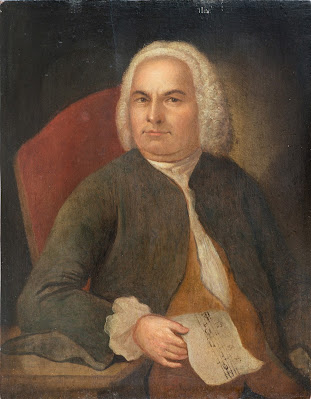
A portrait of Bach
 
I have been listening to a lot of Bach lately. There is so much to explore!

Bach was an important composer to Robert Anton Wilson. I generally associate RAW with his love of Beethoven, but it's clear Bach was important to him, too. In "Credo," in the book Right Where You Are Sitting Now, Wilson writes, "I believe in Bach, the creator of heaven and earth ... " In Prometheus Rising, Wilson remarks that Bach "may have written the sexiest music in history" and makes other references to Bach. 

Another of my favorite writers, Richard Powers, also writes about Bach. There's a lot about the "Goldberg Variations" in Powers' novel The Gold Bug Variations, but references to Bach also pop up in many of Powers' other books. 

If you do decide to dive into Bach, where to begin? Tyler Cowen offers this short list: "Bach's B Minor Mass and St. Matthew's Passion, The Art of the Fugue, WellTempered Klavier, some of the organ music, the Brandenburgs, the Partitas, the Goldberg Variations, and the solo violin works."

That's a pretty good list, but I tend to concentrate on the cantatas, which have many of Bach's greatest hits. I listen to the BWV 140 cantata, Wachet auf, over and over again. I first encountered it in a college music appreciation class and have loved it ever since. I also like the Hunting Cantata, which includes "Sheep May Safely Graze." And I've been listening in December to much of Bach's Christmas music, including his Christmas cantatas. I'll likely explore other cantatas during the new year. There is so much of them.  (I'll mention again that the Bach Guild's digital recordings on Amazon are a really cheap way to build a classical music collection. The "Little Baroque Christmas Box," which I bought about a week ago, has four Bach Christmas cantatas, plus albums by Apollo's Fire and LionHeart. 99 cents.)

One feature of Bach's music that interests me is that it seems to be amenable to endless rearrangements for different instruments. I became familiar with many of Bach's best-known tunes from the Switched on Bach album. A pop group, Apollo 100, had a hit song on Top 40 radio in 1972 with "Joy," an arrangement of a song from Cantata Number 147. There are probably all sorts of other examples I'm not thinking of. 

I don't know what Bach RAW liked to listen to. Maybe Eric or Rasa might know?