Robert Anton Wilson and Robert Shea. Blog, Internet resources, online reading groups, articles and interviews, Illuminatus! info.

Showing posts with label PQ. Show all posts

Wednesday, February 25, 2026

PQ on Joyce and the state violence of evil days


Joyce and Militarism, a book cited by PQ. 

Peter Quadrino has a new piece up at his "Finnegans, Wake!" blog. The new posting is "Evil Days": Joyce and State Violence and it refers to recent events in the U.S. but mostly discusses the brutal repression by Britain when the Irish were trying to achieve independence.

As Peter explains, Joyce had quite a few friends who  were killed by the British, including in the wake of the Easter uprising. (Peter calls these killings "executions," but I think that implies more of a due process than many of the Irish rebels got). Here is Peter on one of the killings:

"One of Joyce's school friends was named George Clancy, he appears in Portrait as Davin, later he became the mayor of Limerick. He was the mayor when one night, the Black and Tans dragged him out of bed and summarily executed him in front of his family. This was in 1921. Joyce was remembering the shock of this almost 15 years later, in a letter to his son Giorgio 4 Feb 1935 he mentions "my poor friend George Clancy (Davin in Portrait). ... He was afterward Mayor of Limerick and was dragged out of bed by the Black and Tans in the night and shot in the presence of his wife." (Letters 1, Gilbert, p. 357)


Thursday, January 29, 2026

Oz Fritz on Pynchon's 'Shadow Ticket'


Oz Fritz has written a long blog post on Thomas Pynchon's latest novel, Shadow Ticket, "Magic Realism in Pynchon's Shadow Ticket." ("This post will inevitably contain spoilers," he warns).

Here is a bit to give you an idea:

"Common knowledge in the Pynchon universe holds that his historical novels include some subtext on the present time. Shadow Ticket is set mostly in 1932 when Fascism appeared in the ascendent around the world including the United States. Fascism plays a dominating role in the novel both in the macro geopolitical aspect and with the individual experiences and encounters by the characters. The story's timeline finishes around Christmas 1932. Hitler was appointed Chancellor of Germany in January, 1933. The Hitler movement in the U. S. first comes into the picture at the start of chapter 4. Hitler gets blended with Charlie Chaplin's humorous caricature of him from The Dictator followed by a serious portrayal that seems accurate until he's described as someone who "says whatever comes into his head." The real Hitler did not have that trait, he never went off script in his meticulously crafted speeches. This kind of verbal diarrhea clearly fits a contemporary American politician."

I can't summarize everything in the review, but there's an interesting comparison between Pynchon and the likes of Robert Anton Wilson and Vladimir Nabokov. The post ends with "To be continued ..." so keep an eye out for more. 

See also Eric Wagner's review at this blog.  And you can read Peter Quadrino's review, too! 


Thursday, September 4, 2025

Who's our greatest living novelist?


Richard Powers (Creative Commons photo by Phoebe Ayers, details here.)

In his recent piece on Thomas Pynchon that I blogged about a few days ago, PQ writes, "Pynchon is arguably the greatest living novelist on the strength of Gravity's Rainbow (1973) alone ... "

This is obviously not an unreasonable opinion, but it made me wonder what other writers plausibly could be suggested. (For the sake of discussion, let's limit this to writers from the U.S.) Colson Whitehead? Don DeLillo? Anne Tyler? N.K. Jemisin? Alice Walker? Stephen King? Percival Everett? Barbara Kingsolver? Who am I missing?

My three favorite "name" writers are Richard Powers, Neal Stephenson and Tom Perrotta. Whenever any of those three issues a new book, I have to read it, ASAP. 

Powers probably would be the writer among those three with the biggest literary reputation. He won the National Book Award for The Echo Maker, the Pulitzer Prize for The Overstory and was awarded a MacArthur "genius" grant. The Gold Bug Variations is another well-regarded novel, and I liked Playground, the one that came out last year. 

I actually interviewed Powers via email after another novel I liked, Orfeo, was published, here is my interview. 


Thursday, August 28, 2025

PQ on Pynchon

 PQ has a new post up about Thomas Pynchon, worth a careful read, here is the opening bit:

"Back in April, a screaming came across the sky, the announcement of a new Thomas Pynchon novel, to be published in October, entitled Shadow Ticket. This marks a literary event, an unforeseen comet spark in the darkness. Pynchon is arguably the greatest living novelist on the strength of Gravity's Rainbow (1973) alone, but the reclusive 88-year-old had not published any new books since 2013's Bleeding Edge, so his fans might've been forgiven for thinking his days of writing new stuff might be over."

The title of the piece is "Return of the Counterforce." Peter explains what the Counterforce is and reveals his favorite Pynchon novel. Here is another bit:

"I'm glad to see in the summer of 2025, Thomas Pynchon is now having a moment. It means great literature is having a moment. A new book from such a legendary writer is some of the best news of this year. I've been seeing copies of Vineland stacked forefront in bookstores across the country in the past year. A new movie inspired by Vineland is about to drop, with Benicio del Toro and DiCaprio. And then we get Shadow Ticket. Something like the counterforce is returning."

Tuesday, June 4, 2024

PQ on Walt Whitman's influence on James Joyce


Walt Whitman in 1862  (public domain photo by Matthew Brady).

 A new post from Peter Quadrino for those of you who are interested in James Joyce.

"Lately, I've been interested in Walt Whitman (1819-1892) and what impact he had on James Joyce (1882-1941), and this influence seems more significant than most commentators have tended to note."

More here. 

I don't remember RAW talking about Whitman, but I'm sure RAW read him, Whitman was such a major and influential American poet. 

Thursday, November 16, 2023

PQ on being in the Guardian


Peter Quadrino (photo from X)

I had missed it when I wrote yesterday's blog post, but Peter Quadrino has weighed in about being featured in the Guardian's article about the Gerry Fialka reading group for Finnegans Wake. Excerpt: 

"I am honored to be a part of this celebration of Wake reading groups around the world. The author, Lois Beckett, did a great job covering the oddity of one-page-a-meeting reading groups dedicated to Joyce's bizarre night-book. To look at a global newspaper and see the front page with all the wars and turmoil and then have this article appear next to all of it feels like a celebration of the eternal forces of creativity and imagination. Poetry, the realm of the mind, the joy of art, language and humanity, remains undefeated."

More here. 


Wednesday, November 15, 2023

Finnegans Wake reading group finishes first pass after 28 years


Gerry Fialka. (Creative Commons photo by David Healey, source.) 

Two familiar names pop up in the  Guardian's article about a Finnegans Wake study group in Venice, California, that has completed its first survey of the book after 28 years.

Peter Quadrino, 38, joined Fialka’s group around 2008 or 2009. He would drive up three hours from San Diego, where he lived, to attend the meeting. “If you’re really interested in Finnegans Wake, it’s kind of hard to find people who will talk about it with you.”

Because Joyce spent 17 years of his life working on the book and then died not long after it was published, “He didn’t really get to explain it,” Quadrino said. “It’s up to us to figure it out, and figure out why he was so devoted to it.”

When Quadrino moved to Austin, Texas, in 2011, he did not want to stop reading, so he put up fliers around town, put some ads in the newspaper, and started his own Texas-based group. Twelve years in, Quadrino’s group is now about halfway through Finnegans Wake, putting them on track to complete the whole thing in about 24 years.

Joyce scholar (and RAW scholar) Eric Wagner has said one of his favorite maxims is "slowness is beauty." I looked closely at the photo accompanying the article but I didn't see Eric. 

Gerry Fialka, the guy who organized the group, did a long interview with Bobby Campbell that I wrote about a couple of years ago.   Fialka worked for Frank Zappa for years and has done other interesting things, see this Wikipedia bio. 

Just to be clear, Gerry's group hasn't finished but has begun again on studying the Wake. 

Saturday, July 8, 2023

PQ reviews books by Joyce


At his Finnegans, Wake! blog, Peter Quadrino reviews five different recent books about James Joyce.  Plenty of RAW fans are also Joyce fans, but PQ stands out as a serous scholar -- he describes making three trips to Dublin in the span of nine months, including one in which he delivered a paper at a Joyce symposium.

Of the five books  he reviews, one, The Book About Everything: Eighteen Artists, Writers and Thinkers on James Joyce's Ulysses, seems particularly aimed at nonspecialists like me: "Despite eighteen different voices with vastly different approaches to discussing a complicated novel, the prose throughout this book is refreshingly easy to consume, the collection feels well-edited and stands among the best recently published Joyce books for the general reader."


Thursday, January 6, 2022

Peter Quadrino goes to Dublin

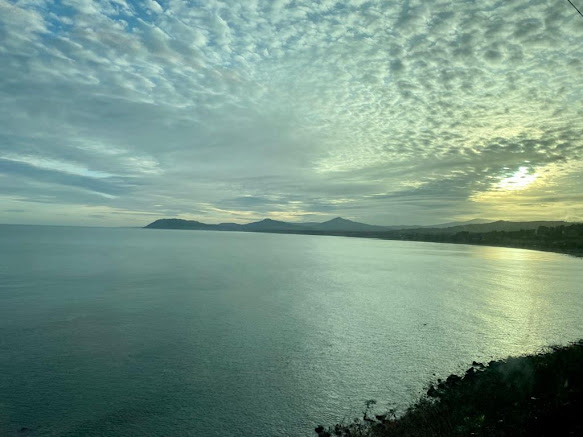
The view from Vico Road

"This past summer, in the midst of a breakup from a long-term relationship and needing to go far away, I embarked on my first ever trip to Ireland. I ended up spending much of the past few months in and around Dublin."

So writes Peter Quadrino, aka PQ, who many RAW fans will recognize as a blogger who has been immersed in the works of James Joyce for many years. You'll want to read his latest blog entry, "So This Is Dyoublong?" Living inside the World of the Wake, Part 1"

"I grew up in New York City where famous sights like the Manhattan skyline, Verrazano Bridge, and Statue of Liberty were familiar aspects of home. An out-of-towner visiting a place like New York City for the first time would instantly recognize many of the landmarks and sights from the background or setting of the worlds of NYC-based films and tv shows. With Joyce's Dublin though, the city is not merely the setting for Finnegans Wake---so much of the book is about the landscape itself, the ecology, the littoral life of the coastal zone, the street grid and its voices, the layers of historical events that shaped the place. Dublin in the Wake becomes the universal city, a city rendered into text with so much mythical depth and detailed density it makes you contemplate all cities."

"On days when I wandered around in what seemed like a James Joyce theme park (a phrase I'm borrowing from former Dublin resident Robert Anton Wilson), casually walking down Westland Row, past Finn's Hotel, down to St. Stephen's Green, past the Shelbourne Hotel, over to King Street past the Gaiety Theater, back towards Grafton Street, up past Trinity College (all places that appear throughout Finnegans Wake) and then along the River Liffey, the river of life, the universal river Joyce anthropomorphized as Anna Livia Plurabelle in the Wake, I'd stop to stare at the varying ripples along the surface of the waters ... "

More here. 


Tuesday, February 16, 2021

PQ's horrible year

PQ's dog, Roa

If you missed it, PQ has a blog entry up about 2020 at his A Building Roam blog. 

As in past years, "Life and Death During the Pandemic Era" talks about what Peter  read and wrote during the last year and there's even a section on his dog, although sports talk is notably absent. But the bulk of the piece is a moving description of friends who died last year (not all of the deaths seem to be directly related to the pandemic.)

With all that stuff going on, I lost three friends in the pandemic year, three people I liked and connected with, funny people who made me laugh, three people who, going into 2020, I did not at all consider I might never see again or that they might not live to see 2021. From the shock of those deaths I spent much of the past year in a state of grieving. It's been difficult to process it all, felt like painful debts accumulated because how can we pay due respects to the dead when we can't gather to honor their memories in wakes or funerals?

Tuesday, April 30, 2019

'Finnegans Wake-End' interview


PQ interviews Derek Pyle (the "Waywords and Meansigns" organizer) and Gavan Kennedy about "Finnegans Wake-End," a series of events for the birthday of Finnegans Wake, which is May 4.

I know people find about about Joyce's book in a variety of ways, but I would not have guessed that for Pyle, it was Marilyn Manson.

Derek also has a new podcast in the works. 

Tuesday, June 26, 2018

A 'Finnegans Wake' Pantheon


Two Finnegans Wake fans mentioned in PQ's piece: Joseph Campbell and Jean Erdman, in 1939 or so.

PQ has a new blog post up, The Pantheon of FINNEGANS WOKE (or Why Read Finnegans Wake? Testimonials from Famous Wakeans) which chronicles the various famous writers, musicians, critics etc. who have been fans of James Joyce's book. Robert Anton Wilson is one of the writers cited, and in fact part of an interview with RAW inspired PQ to write the paper that he turned onto a blog post. PQ is inviting folks to add others in the comments, and I've already chipped in.

Saturday, March 14, 2015

Hear PQ perform Finnegans Wake


Peter Quadrino

You've read PQ's blogs Finnegans, Wake! and A Building Roam,  you have seen him mentioned many times on this blog, now listen to  him perform a bit from Book III, Chapter 3 of Finnegans Wake, accompanied by music and other voices. The production from the Finnegans Wake reading group in Austin, Texas, where Peter Quadrino lives, is part of the Waywords and Meansigns project, which is attempting to record the entire book; only samples are available now. The player, below, has all of the samples released so far; PQ's is the one that sounds like wind howling at the beginning. Or go here and pick out  the sample you want. Steve "Fly" Pratt is working on the project, too, although a sample from him apparently is not available yet.

Tuesday, February 10, 2015

Finnegans Wake link roundup from PQ


A photo of William S. Burroughs from Vagabond Bohemia. 

Over at Finnegans, Wake!, PQ has a nice roundup on new Wake sites, including Vagabond Bohemia, a Tumblr that has "plenty of Joyce material as well as a whole universe of artwork, plus Thomas Pynchon, Marshall McLuhan, Salvador Dali, Robert Anton Wilson, and other great explorers of the frontiers of the mind." Other Wake links are on the right side of PQ's blog. Finnegans Wake is the major Joyce work I have to tackle, but it is next.

Saturday, June 21, 2014

PQ on the new book on Joyce's Ulysses


I have blogged 2-3 times on Kevin Birmingham's The Most Dangerous Book: The Battle for James Joyce's Ulysses  but PQ has now put up a much more definitive blog post explaining the book and linking to many reviews of it. PQ also has some other cool Joyce links, including a 1922 Vanity Fair article about Joyce written by Djuna Barnes! Excerpt from the Vanity Fair piece:

Because he had heard of the suppression of The Little Review on account of Ulysses and of the subsequent trial, he sat down opposite me, who was familiar with the whole story, ordering a white wine. He began to talk at once. “The pity is,” he said, seeming to choose his words for their age rather than their aptness, “the public will demand and find a moral in my book—or worse they may take it in some more serious way, and on the honor of a gentleman, there is not one single serious line in it.”

PQ is reading the book and says he'll write more about it. I am eager to read his observations.

Friday, February 28, 2014

'The Allure of Reading'

PQ has a nice piece up "On the Allure of Reading" and the difficulty of getting to everything that he wants to read. I totally relate -- I have started listening to audiobooks on my commute to work more often because it increases the total number of books I am able to consume.

When I got out of college, more than 30 years ago, I was swept with an enormous feeling of relief, because I could choose which books I wanted to read in my spare time, as opposed to having to read the books my college professors wanted me to read.

Each time I choose which book to read next, I have to decide between a book that relates to this blog and one that has no connection. There's always a little bit of guilt when I'm not doing my "homework."


Monday, February 3, 2014

Odyssey/Ulysses

I just finished re-reading the Robert Fitzgerald translation of The Odyssey and this weekend I began reading James Joyce's Ulysses and started Ulysses by Hugh Kenner and Ulysses and Us by Declan Kiberd.

I read The Odyssey again because I wanted to have it fresh in my mind before reading Ulysses. When I read it this time, I was struck by how it could be read as a tribute to barbecue. Over and over again, the action stops while everyone gorges on meat from a freshly-slaughtered animal. Usually the epic specifies that bread is served on the side, just as in a Southern barbecue joint. I subscribe to the email list for the Bryn Mawr Classical Review,  which just ran a review of a book called The Meaning of Meat and the Structure of the Odyssey by Egbert J. Bakker (only $90 from Oxford University Press). The reviewer, Jeremy McInerney, mentions a suggestion by one scholar, Andrew Dalby, "that the emphasis on heroic meat-eating is an instance of wish-fulfillment aimed at an audience of subsistence farmers."

I also was struck by how the description of the behavior of Ulysses and his crew (and by extension, Greeks on ships in general) reminded me of the Vikings. The Odyssey describes how Ulysses and his force, early in their attempt to return to Ithaca, attack and sack a city of the Cicones, apparently because they could. Greeks aboard ships, as colonizers, founded cities all over the Mediterranean and environs, including in Italy, Sicily, southern France and the Black Sea. This would seem to be the biggest explosion of ship-borne peoples until the time of the Vikings, who ranged from North America to deep inside Russia. Dublin, very early in its history, was a Viking settlement.

When I was in high school, I read Dubliners. I started Ulysses the summer after I graduated from high school but was unable to finish it. I finally read Ulysses a few years ago and finished it, but had the feeling that I wasn't really understanding much of it.

My original plan was to re-read Ulysses and, at the same time, read the Kenner and Kiberd books. I've gotten interested in Ulysses, however, and I think I will finish it before I resume the two books of criticism. I'd like to think I can read it as I read any other novel, and get something out of it.

Speaking of James Joyce, PQ published a lovely birthday tribute to Joyce Sunday.

Monday, January 13, 2014

PQ reviews Finnegans Wake book

I'm currently re-reading the Robert Fitzgerald translation of the Odyssey. That's in preparation for my plan to re-read Ulysses later this month.

So it will be later this year before I can get around to tackling Finnegans Wake. But when I do, PQ will be one of my main guides.

PQ has now written a two-part review of a book about Finnegans Wake that came out about four year ago, [I got that wrong, see PQ's comment]  Joyce's Book of the Dark by John Bishop. Part one is here; part two is here. 

PQ's verdict? "Joyce's Book of the Dark is a masterpiece of literary criticism while at the same time an eye-opening scholarly consideration of sleep. Bishop begins with the provocative premise that Finnegans Wake is, at all times, a record of what goes on inside the body and mind of one sleeping person (that is, not just dreams, but even the extended mysterious dreamless periods) and proceeds to build upon that argument almost ad nauseam, deploying snippets from the text of the Wake relentlessly through twelve progressively groundbreaking chapters concluding with a most brilliant and original theory of what the flowing female character Anna Livia Plurabelle really represents in the book ... Many readers consider Joyce's Book of the Dark to be the finest analysis of Finnegans Wake that's ever been written and I have to agree. "

Robert Anton Wilson on Finnegans Wake. 


Sunday, December 22, 2013

Joyce's Portrait of the Artist' — non serviam, I will not serve

James Joyce, aside from his inherent interest as a major writer, is interesting to Robert Anton Wilson fans because of the influence Joyce had on RAW's writings. I have been reading Joyce lately; this year I read Chamber Music and re-read Dubliners, and I just finished reading A Portrait of the Artist as a Young Man. 

Reading Coincidance was good preparation for reading Portrait, as is reading Wilson in general. Project Gutenberg has versions of the books in various formats; I read mine on my Kindle. (Of course, Gutenberg has just about everything by Joyce except Finnegans Wake). If you are on the fence about doing a Joyce read-through, see PQ's "16 Reasons Why James Joyce is the Greatest Writer Ever." 

PQ observes, in his "The Exasperating, Inexhaustible Simplicity of James Joyce's Portrait" that reading Portrait is a good preparation for reading Ulysses, and I am glad he says so, as I plan to re-read Ulysses next month.

Portrait is interesting stylistically; it begins with the language and point of view of a small child and then shifts into other styles and literary modes, including, of all things, fiery and vivid sermons on the nature of hell.

My favorite portions of the book were the declarations Stephen makes as he forges his own philosophy. Those were the parts I bookmarked.

For example, toward the end of the book, the hero, Stephen Dedalus (a person much like Joyce himself) calls away his friend Cranly and had a discussion with him about Stephen's obsessions, including his views on art and religion:

— Do you believe in the eucharist? Cranly asked.

— I do not, Stephen said.

— Do you disbelieve then?

— I neither believe in it nor disbelieve in it, Stephen answered.

— Many persons have doubts,  even religious persons, yet they overcome them or put them aside, Cranly said. Are your doubts on that point too strong?

— I do not wish to overcome them, Stephen answered. 

Stephen rejects pressures to conform to others' demand that he give obedience to religion or political movements:

After a pause Cranly asked:

—What age is your mother?

—Not old, Stephen said. She wishes me to make my easter duty.

—And will you?

—I will not, Stephen said.

—Why not? Cranly said.

—I will not serve, answered Stephen.

Stephen is committing, in the eyes of the church, the sin of pride. Here is a paragraph from one of those sermons earlier in the book:

—Adam and Eve, my dear boys, were, as you know, our first parents, and you will remember that they were created by God in order that the seats in heaven left vacant by the fall of Lucifer and his rebellious angels might be filled again. Lucifer, we are told, was a son of the morning, a radiant and mighty angel; yet he fell: he fell and there fell with him a third part of the host of heaven: he fell and was hurled with his rebellious angels into hell. What his sin was we cannot say. Theologians consider that it was the sin of pride, the sinful thought conceived in an instant: NON SERVIAM: I WILL NOT SERVE. That instant was his ruin.

Here is Stephen's key declaration to Cranly toward the end of the book, when he has rejected pressures from the church, his mother, the Irish nationalists among his fellow students, etc.:

—Look here, Cranly, he said. You have asked me what I would do and what I would not do. I will tell you what I will do and what I will not do. I will not serve that in which I no longer believe, whether it call itself my home, my fatherland, or my church: and I will try to express myself in some mode of life or art as freely as I can and as wholly as I can, using for my defence the only arms I allow myself to use—silence, exile, and cunning.

The phrase "non serviam" is used three times in Illuminatus!, to explain the essence of libertarianism (or, if you prefer, anarchism).


Friday, November 1, 2013

PQ book review roundup

PQ  has a roundup of various books that I have read or wish that I had read, including books we've recently discussed here. I was particularly interested in his review of Neuropolitique by Timothy Leary and Robert Anton Wilson, which I haven't gotten to yet. He writes, ". My favorite aspect of Leary's spiel tends to be his view of DNA and evolution and I love the way he ties space migration into this. He likens space migration to "the movement from marine to amphibian life or from reptile to mammalian." Why don't people say this kind of stuff anymore?"