Robert Anton Wilson and Robert Shea. Blog, Internet resources, online reading groups, articles and interviews, Illuminatus! info.

Showing posts with label Buckminster Fuller. Show all posts

Thursday, December 29, 2022

I enjoyed the Claude Shannon biography


I don't know how history is taught here in Japan, but in the United States in my college days, most of the time was spent on the study of political leaders and wars -- Caesars, Napoleons and Hitlers. I think this is totally wrong. The important people and events of history are the thinkers and innovators, the Darwins, Newtons and Beethovens whose work continues to grow in influence in a positive fashion.

-- Claude Shannon, quoted in A Mind At Play

Spurred by listening to the recent Hilaritas Press podcast on Claude Shannon, the American mathematician mentioned in RAW's works, I spent the week reading A Mind At Play, the biography written by the two co-authors Mike interviewed in the podcast, Jimmy Soni and Rob Goodman.

Shannon essentially invented information theory and led the way for the digital age with his seminal 1948 paper, "A Mathematical Theory of Communication." Among other points, Shannon showed how all messages could be transmitted using the binary digits or "bits" used by computers, showed how noise could be eliminated from messages (it was previously assumed, the authors say, that noise in messages was just something you had to put up with), showed how files of information can be compressed and provided other insights. The authors also cover Shannon's other work, including many devices that showed how Shannon's mind worked and how he liked to amuse himself. (He invented a wearable computer to use in casinos while trying to win at roulette, an early chess playing computer and a flame throwing trumpet. One of Shannon's devices that amused me had a switch that was flipped to be turned on. When you flipped the switch, a hand would emerge and turn the switch off!)

I did my best to follow the authors' technical explanations. Next I plan to read another book dealing with information, James Gleick's The Information: A History, a Theory, a Flood, which apparently also has quite a bit about Shannon. 

I can't help but notice how different Shannon was from another subject of a Hilaritas podcast, Buckminster Fuller. As Alec Nevala-Lee's biography shows,  Fuller did have many interesting ideas, but he fibbed constantly about his biography and achievements, took credit for other people's ideas, exaggerated his successes and constantly sought fame and acclamation. A Hilaritas podcast with Kurt Przybilla covers some of Fuller's ideas and also transmits some of Fuller's self-serving BS, although to Przybilla's credit, he corrected podcast host Mike Gathers when Mike suggested that Fuller might be the kind of person who didn't worry about credit. (The podcast came out before the Nevala-Lee book, so neither the host nor the interviewee had access to Nevala-Lee's revelations). 

Shannon simply pursued his own interests. He avoided publicity when he could and tried to avoid being turned into a guru. 

After Shannon became famous, he wrote a piece called "The Bandwagon" in which he tried to discourage others from turning Shannon's information theories into all-purpose explanations for unrelated fields. And when Fortune magazine ran a piece on Shannon, with two opening paragraphs hailing Shannon's genius, Shannon protested that "communication theory is not in the same league with relatively and quantum mechanics."

It's also telling, I think, that Fuller apparently made up a story about Albert Einstein appreciating Fuller's genius while Shannon downplayed his interactions with Einstein, merely saying they sometimes waved to each other. Shannon worked for awhile at the Institute for Advanced Study at Princeton, where Einstein was the most famous scholar. According to one story, one time when Shannon was lecturing, Einstein wandered into the classroom, listened for awhile, whispered into the ear of a man at the back, and then left. When he finished his class, Shannon rushed to the back of the room to find out what the great man had said. Einstein had asked where to find the bathroom!


Thursday, August 4, 2022

New York Times reviews new Bucky Fuller biography


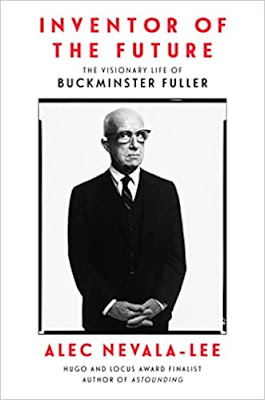
Alec Nevala-Lee's new biography of Buckminster Fuller will be of interest to many RAW fans because (1) Fuller was a big influence on RAW and (2) Lee does a great job with the new book, Inventor of the Future: The Visionary Life of Buckminster Fuller, which came out this week. 

The New York Times has just reviewed the book, and I notice that the reviewer, Witold Rybczynski, reaches exactly he same conclusions as I did when I reviewed the book: "The strength of this carefully researched and fair-minded biography is that the reader comes away with a greater understanding of a deeply complicated individual who overcame obstacles — many of his own making — to achieve a kind of imperfect greatness."

Here is my review, where I wrote: "Alec Nevala-Lee's new book about Buckminster Fuller, Inventor of the Future: The Visionary Life of Buckminster Fuller, is a big, carefully researched account that seems likely to become the definitive biography of Fuller. 


Sunday, June 19, 2022

Review: 'Inventor of the Future,' the Bucky Fuller biography


Alec Nevala-Lee's new book about Buckminster Fuller, Inventor of the Future: The Visionary Life of Buckminster Fuller, is a big, carefully researched account that seems likely to become the definitive biography of Fuller. 

Nevala-Lee's previously best-known nonfiction work was Astounding, a book about John Campbell, Isaac Asimov, Robert Heinlein and L. Ron Hubbard and the golden age of science fiction, at least in the eyes of contemporary fans. It's a great book which every science fiction fan should read, but perhaps it was not a topic that would provide a best seller. Given Fuller's fame, this excellent new biography, out August 2, seems likely to win Nevala-Lee many new fans. 

While this book was a labor of love for Nevala-Lee -- he discovered Fuller as a teenager and became a lifelong fan, he explains in the book's acknowledgements section -- it is hardly an uncritical hagiography. Nevala-Lee writes in the Prologue that while there have been many books about Fuller, many have been "riddled with errors." It is Nevala-Lee's intention to write "a comprehensive biography that covered  his full career using the best available sources" and to give Fuller "exhaustive, respectful but unsentimental treatment."

As I waded into the book (more than 600 pages), it quickly became clear why many previous books about Fuller have many errors; it's because they relied largely on Fuller, and Fuller, to put it charitably, was an unreliable narrator. In fact, he often made false statements, about himself and his inventions and ideas, and even allowing for the fact that many people tend to misremember elements of their own lives, it seems that Fuller was not a particularly honest person. So it's not true, for example, that Fuller stopped speaking for months after having his transformative experience in 1927 on the shore of Lake Michigan.

In fact, a big surprise for me as I got into the book was discovering that I just did not like Fuller very much. He had a bad habit, for example, of appropriating the ideas of other people and claiming them as his own. (Nevala-Lee writes that Fuller made good use of groups of college students, and "he carried the discoveries of each group of students to the next school on his list, burnishing his image as a genius by assimilating the work of many others. When credited to him alone, it made him seem staggeringly versatile ... ") Great men who make things happen are often not very pleasant people -- Steve Jobs and Elon Musk are two familiar recent examples -- and Fuller seems to fit into that mold. 

But Nevala-Lee also shows how influential Fuller was. The book's Prologue, which is particularly good, gets the biography off to a fast start by describing Fuller's visit to the campus of Apple and showing how Fuller was a particular inspiration to many important Silicon Valley figures, including Jobs.

There is comprehensive coverage of Fuller's geodesic domes and ventures into architecture, his Dymaxion car and other inventions, and his often amusing and interesting interactions with other famous people. He collaborated with the artist Isamu Noguchi, was rather good friends with John Cage, and had encounters with figures including L. Ron Hubbard, Ezra Pound, Arthur C. Clarke and William Burroughs.

Fuller's interactions with Robert Anton Wilson are not described, although Wilson's interview with Fuller for High Times magazine is used as a source and mentioned in the notes. Fuller's influence on Wilson would be hard to overstate -- Fuller is cited in Wilson's writings many times. Fuller pops up in cameo appearances in Illuminatus! and is frequently cited by name in that work. Many Wilson fans will want to read Nevala-Lee's book to learn more about a key influence on RAW.  

Nevala-Lee's book ends strongly with an epilogue on how Fuller's ideas inspired important breakthroughs in chemistry. And the "Acknowledgements" at the back of the book should not be skipped, as it includes Nevala-Lee's recommendations on which of Fuller's books to read to find out more about Fuller's ideas. 

Friday, April 15, 2022

Buckminster Fuller podcast


1950s photo of Buckminster Fuller and Robert Anton Wilson.

While we wait for the new biography by Alec Nevalla-Lee, we can learn a lot about Fuller by listening to last month's Hilaritas Press podcast, hosted as usual by Mike Gathers and featuring Kurt Przybilla, active in the Buckminster Fuller Institute. The podcast is quite long, nearly two and a half hours. The early part features a big does of Fuller's interest in triangles and the sturdy shapes that could be made from them; Mike was able to hastily Google some of the shapes and did a good job of following along; I struggled a bit in places, as I was listening while doing a long car drive. As usual, the Hilaritas site has a useful collection of links and has quotes from Fuller, such as this one: "We are called to be architects of the future, not its victims."

The James Joyce segment of the podcast releases on April 23. 


Wednesday, March 23, 2022

New Hilaritas podcast on Buckminster Fuller

Buckminster Fuller (Creative Commons photo)

Episode 7 of the Hilaritas Press podcast takes on Buckminster Fuller and drops today. Get it at the podcast website, which  also is likely to feature show notes and which lists the various apps where the podcast can be found, for those of you who like to get your podcasts on your smartphone.

Podcast host Mike Gathers has been posting Tweets about Fuller on his Twitter account, which you should follow if you're a RAW fan on Twitter. And don't forget about the new Fuller biography by Alec Nevala-Lee that will be out in August. 

Tuesday, February 8, 2022

Buckminster Fuller biography out in August


In a 2019 blog post, I reported that a new Buckminster Fuller biography was in the works from Alec Nevala-Lee, an author (and RAW fan!) who wrote the excellent book Astounding: John W. Campbell, Isaac Asimov, Robert A. Heinlen, L. Ron Hubbard, and the Golden Age of Science Fiction.

I can now follow up by telling you that Nevala-Lee's Inventor of the Future: The Visionary Life of Buckminster Fuller will be released on August 2.

Here is some of the description from the publisher's  blurb:  "Inventor of the Future is the first authoritative biography to cover all aspects of Fuller’s career. Drawing on meticulous research, dozens of interviews, and thousands of unpublished documents, Nevala-Lee has produced a riveting portrait that transcends the myth of Fuller as an otherworldly generalist. It reconstructs the true origins of his most famous inventions, including the Dymaxion Car, the Wichita House, and the dome itself; his fraught relationships with his students and collaborators; his interactions with Frank Lloyd Wright, Isamu Noguchi, Clare Boothe Luce, John Cage, Steve Jobs, and many others; and his tumultuous private life, in which his determination to succeed on his own terms came at an immense personal cost."

Of course, Robert Anton Wilson was a huge admirer of Buckminster Fuller, references to Fuller fill Wilson's books and Wilson interviewed him, an interview reprinted in Right Where You Are Sitting Now. 

Sunday, January 6, 2019

New Buckminster Fuller biography announced


Buckminster Fuller (Creative Commons photo)

Alec Nevala-Lee, a Robert Anton Wilson fan and the author of a new book on John Campbell Jr. and his major authors, Astounding, announced on Dec. 31 that he will end daily blogging, but not before making an announcement that will interest RAW fans:

 I’ve confirmed I’ll be spending the next three years writing the book of my dreams, a big biography of Buckminster Fuller, which is something that I couldn’t have imagined a decade ago. 

Fuller of course was a big influence on Robert Anton Wilson.

Here is a blog post from Nevala-Lee discussing his plans for the book.

Thursday, December 13, 2012

RAW interviews Bucky Fuller


Robert Anton Wilson's interview with Buckminster Fuller (Pdf) appeared in the May 1981 issue of "High Times" magazine. I'm making it available to you thanks to Mike Gathers. Image via Danny Rollingstone at Robert Anton Wilson Fans on Facebook.


Tuesday, August 14, 2012

Buckminster Fuller's lectures

The excellent Open Culture Web site has posted "Everything I Know," 42 hours of lectures by Buckminster Fuller. (I have an interview of Fuller by RAW that I will post when I manage to find time to transcribe it.)

Pipzi Williams chips in with a haiku:

bucky fuller spoke
and other dimensions leaned
to listen closely

UPDATE: In the comments, Bogus Magus notes that transcripts are available here. I'll be loading some into my Kindle.