Robert Anton Wilson and Robert Shea. Blog, Internet resources, online reading groups, articles and interviews, Illuminatus! info.

Showing posts with label Ezra Pound. Show all posts

Tuesday, November 4, 2025

RAW wrestles with Ezra Pound's good and bad


I haven't gotten very far in Non-Euclidian yet, but I have gotten far enough to notice that the editors chose many pieces written early in RAW's writing career. RAW himself, with some exceptions, did not use much of his early work when he was alive and was selecting the pieces for his own anthologies. He sometimes disparaged his early work, although I also wonder if he did not have easy access to much of it.

In any event, the use of early pieces in A Non-Euclidian Perspective means that the reader gets a look at how RAW's writing style and political thought evolved during his career. Some of those early pieces are not really my favorite bits of RAW writing, but I did very much like "Ezra Pound and his Admirers," where RAW confronts his admiration of Pound and his loathing for his politics:

"Two statements which I am arrogant enough to call 'facts' must be placed on record in any intelligent discussion of Pound: (1) He is a great poet and a great thinker; (2) He has deliberately and consistently support fascism, anti-Semitism and other vicious systems and attitudes for 30 years now, and continues to do so ... Placed together, those facts make a paradox which is both tragic and highly alarming. Most of us prefer not to face that paradox, and we reduce Pound to one part of it and ignore the other part." 

Later:

"To see Pound as he  is -- a man of genius and goodwill, of folly and rage, of love and integrity and hatred and dishonesty -- is to admit that such contradictions can exist in the human personality. That is not a comfortable thought -- it is especially uncomfortable to those of us who are, like Pound, idealists intent on changing the world -- so we prefer to brush it aside and go on playing our life-myth that the universe is one big Western Movie where the 'good guys' (us) are fighting the 'bad guys' (our enemies.)"

I am grateful to the editors for getting this book assembled, so I could read this piece and the other pieces.

Related: Substack from Michael Johnson: "Ezra Pound, RAW and The 'Two Cultures'."


Saturday, April 22, 2023

Eric Wagner on Ezra Pound, RAW and 'Intolerance'


Scene from the 1916 film Intolerance (Alfred Paget as Prince Belshazzar).

In the latest regular Hilaritas podcast, featuring Eric Wagner on Ezra Pound, Eric contends that to really understand Robert Anton Wilson, the reader must wrestle with Ezra Pound.  Eric is, as I've mentioned before, the author of the revised edition of An Insider's Guide to Robert Anton Wilson; I keep the Kindle on my phone for ready reference. 

One important point Eric makes early in the hour-long podcast with Mike Gathers is that regardless of what one thinks of Pound's more dire views,which he recanted late in life, he played a major role in assisting many of the top writers of the 20th century, including James Joyce, T.S. Eliot and Ernest Hemingway. Eric also makes reading recommendations for Pound, but see also his recommendations in the comments for my earlier post on the podcast. 

One  other point: Eric remarks in passing that Illuminatus!  "based on" D.W. Griffith's movie Intolerance. While I knew Wilson admired the film,, I didn't  know (or at least didn't remember) that the movie influenced Illuminatus!, so I did some searching. In this interview of RAW by Neal Wilgus, RAW, referring to Illuminatus!, says, "The narrative technique is based on D.W. Griffith’s Intolerance, which I think is the greatest movie ever made." (The interview is excerpted in The Illuminati Papers, but not the bit about Intolerance.)

Intolerance is a three-hour epic, but evidently I need to get around to watching it. 

A question for Eric: Robert Shea's acknowledgements for All Things Are Lights mentions RAW. Should we guess that RAW recommended Pound's The Spirit of Romance, and that the book influenced Shea's novel? 

Thursday, March 23, 2023

New Hilaritas podcast: Eric Wagner on Ezra Pound

The new Hilaritas Press podcast, released today, features guest Eric Wagner discussing a key influence on Robert Anton Wklson: The poet Ezra Pound. Mike Gathers returns as host. As usual, the official site for the podcast has links for more information. This is a topic Eric knows a lot about, and I expect to be listening soon. 

Sunday, December 19, 2021

'The Downfall of Ezra Pound'


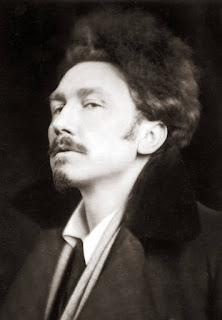
Ezra Pound in 1920 by E.O. Hoppe

The New York Times has a nice feature for its subscribers;  while the newspaper has a paywall, it provides ten links a month for sharing articles.

So here is a cartoon about Ezra Pound, "The Downfall of Ezra Pound," which I am sharing because of Robert Anton Wilson's interest in the famous poet. It's by R.O. Blechman, an artist and illustrator. 

Monday, November 6, 2017

A new Ezra Pound book


Mug shot of Ezra Pound, when he went into captivity in 1945. 


"Some critics I respect (Hugh Kenner, Robert Anton Wilson) love him; others (Christopher Hitchens, Clive James) do not; and the latest book about him—The Bughouse, by David Swift—suggests an explanation. Swift says that bad poetry is hard to write about, and there is much of that in Pound, but the good parts are good enough to keep the critics busy," Supergee observes. "As the title suggests, The Bughouse deals with Pound’s years in St. Elizabeths Hospital (which is now headquarters for Homeland Security; you can’t make these things up) after World War II."

The conclusion? "If you are interested in Pound, this is a part of the story well worth reading."


Thursday, May 19, 2016

Eric Wagner and RAW on Pound and Illuminatus!


Eric Wagner, with some friends 

[Eric Wagner, the author of An Insider's Guide to Robert Anton Wilson, recently forwarded me an email exchange between himself and Robert Anton Wilson, dated April 23, 2006. Thought I would share it with you. I haven't changed anybody's words, but I edited and formatted for clarity. Thanks, Eric! — The Management.]

Eric Wagner: I just reread your brilliant chapter on the VIth circuit in Prometheus Rising.  It made me think that many of the goddess and god scenes in the Cantos fit in well with Sheldrake's morphogenetic field theory.  Critters pick up on the morphogenetic fields and perceive the Eleusinian visions that crop up throughout the Cantos, a sort of yoga between the sixth circuit of individual brains and the morphogenetic fields.

Robert Anton Wilson: I suspect Ez decided to become a poet because
he had those visions from childhood on hence despite his rants against religion he
never denies "divinity."

Eric Wagner: What percentage of Illuminatus! did you write, and what percentage did Bob Shea write?

Robert Anton Wilson: I would guess about 2/3 me [mostly humor & surrealism]
and 1/3 Shea [mostly adventure].


Monday, December 16, 2013

When Ezra helped James

Author and critic Ted Gioia, last seen here writing a review of Illuminatus!, has just published an article, at the Daily Beast, about two of Robert Anton Wilson's favorite writers, James Joyce and Ezra Pound. The piece, "The Letter That Changes the Course of Modern Fiction,"  details how 100 years ago Pound, at a critical point in Joyce's life when Joyce was having a great deal of trouble getting any serious work published, Pound wrote Joyce an unsolicited letter and offered to help.

Joyce, Gioia explains, had been unable to find a publisher for A Portrait of the Artist as a Young Man and had even once tried to burn the manuscript. Gioia writes,

"Pound proved of incalculable value to his new friend. In the coming months, he would arrange for the serialization of A Portrait of the Artist as a Young Man in a fashionable literary journal. He sent off Joyce’s short stories to H.L. Mencken, the influential American journalist and editor. Pound also featured Joyce’s poem “I Hear an Army,” written a decade earlier and now all but forgotten, in an anthology of Imagist poetry.

"These two young men were unlikely allies. In his first letter to Joyce, Pound admits: 'I imagine we have a hate or two in common—but that’s a very problematical bond on introduction.'

"But Pound’s efforts on Joyce’s behalf didn’t stop there. He spread word of the Irish author’s genius to his numerous contacts in the literary world, and started laying the groundwork for the later success of Ulysses. In championing his new discovery, Pound brought his work to the attention of Harriet Weaver, later Joyce’s chief financial backer, and Sylvia Beach, the Parisian bookseller who would eventually publish Ulysses. In the face of every obstacle stifling Joyce’s prospects—financial, editorial, legal—his new American friend searched for solutions, and more often than not found them."

It's not a very long piece. Go read it.


Thursday, February 28, 2013

Pound's "The Spirit of Romance"

Over at Overweening Generalist, Michael Johnson has a post on "Gnostic Diffusion Down Through the Ages" that discusses Ezra Pound's book, The Spirit of Romance, which apparently talks about the Cathars in 13th century France and the "courtly love" movement, topics which are focused upon in the Robert Shea novel I just wrote about, All Things Are Lights.

While I try to figure out whether Shea might have been influenced by Pound's book, I wanted to point out that The Spirit of Romance is available as a free download from the Internet Archive.

Saturday, December 29, 2012

Lots of Ezra Pound audio

UbuWeb has a large collection of Ezra Pound audio, including poetry readings and an interview. (Hat tip: John Merritt).

More: video of Pound being interviewed. (Click on CC when the interview is running to get captions). "No politics, but a Communist interviewing a Fascist is ironic," Merritt comments.

Thursday, October 18, 2012

Assorted Links

Bobby Campbell is maintaining a page where he posts links to all of the episodes of Agnosis posted so far. (Also posted, for your convenience, under "Resources."

A book on Ezra Pound's economics theories. (Hat tip, John Merritt.)

Timothy Leary's prison correspondence with Carl Sagan. 

Video of Leary interviewed at Folsom Prison.  (Thanks again to Mr. Merritt.)

Jack Sarfatti's VALIS experience. (He's mentioned in Cosmic Trigger I, and probably also other RAW books.) Via Ted Hand, on Twitter,

Friday, January 27, 2012

Italian neofascist homage to Ezra Pound

From the pages of The Guardian, an article about the Italian neofascist group CasaPound, which takes its name from Ezra Pound. Pound's 86 year old daughter is not pleased. (Via Ted Gioia on Twitter.)

Wednesday, July 20, 2011

An Ezra Pound conspiracy theory

I've been reading The City of Falling Angels by John Berendt, about the city of Venice. It's a lot of fun.

Chapter 9, "The Last Canto," has a conspiracy theory about the fate of many of Ezra Pound's literary papers, which naturally I am sharing with you.

Many of his papers wound up being preserved and placed in collection in a library at Yale University.

Berendt's theory is that an expatriate American, Jane Rylands, took advantage of Pound's mistress, Olga Rudge, by forming the "Ezra Pound Foundation," enriching herself in the process. All of the elements of the theory cannot be proved, because the alleged conspirators concealed some of the evidence.

The three officers of the foundation were Rudge, Rylands and a Cleveland lawyer (not named in the book.) Any decisions of the foundation would be made be a majority vote of the three.
In other words, when Rudge realized that she was being taken advantage of, she was outvoted.

The foundation was dissolved after the papers were sold to Yale. "There were rumors that Yale had paid Jane Rylands a considerable sum of money for the papers, but they were only conjecture." (Page 210).

The Olga Rudge Papers at Yale consist of 208 boxes of materials. Scholars can read the material in 207 boxes. One box, No. 156, has the papers of the Ezra Pound Foundation, and Yale has placed that box off limits until 2016. According to Berendt's book, Rylands and the unnamed Cleveland lawyer insisted upon that condition.

Monday, June 27, 2011

R. Michael Johnson on ILLUMINATUS!

R. Michael Johnson has a typically erudite article on ILLUMINATUS! and Robert Anton Wilson's "Guerilla Ontology" at Suite 101. It's a short article written for general readers, but you're likely to learn something, anyway. (I didn't know that Edward Abbott's Flatland influenced the structure of ILLUMINATUS!) Don't forget to do the social media thing (e.g., "liking" it on Facebook) so that the piece can find a few more readers.

Michael also has a piece on Ezra Pound in case you need to brush up on the key RAW influence.

Wednesday, March 23, 2011

RAW reviews Pound's prose

(Here I reprint Robert Anton Wilson's article from "Conspiracy Digest," Spring 1978, Vol. 3, No. 2. Thank you to Mike Gathers for supplying the piece.)

BOOK REVIEW

By Robert Anton Wilson

Selected Prose 1909-1965, by Ezra Pound. New Directions, New York, 1973. 475 pages. $4.75.

Ezra Pound, probably the greatest poet of the 20th Century, was obsessed with the injustices of modern banking which he characterized as a false-system of book-keeping which prevents the producers of wealth from buying back their own product. He wrote about this in essays which grew increasingly angry and "fanatical" in tone as the decades passed, because he found that, despite his recognized literary stature, he could not get anything on this subject printed in any of the major media but only in "little magazines" of limited circulations. Eventually he began to suspect that the major publishers were in collusion with the major bankers, and his writings grew even more angry and "fanatical." Contemporary literary opinion generally regards this whole aspect of Pound's life work as a mania or obsession, but those who think for themselves might form a more favorable impression from this volume which contains nearly half a century of serious research and documentation.

The much-derided "fanaticism" is there, yes; but it is relieved by wonderful humor (Pound was the funniest polemicist of his time, even surpassing Mencken) and by frequent flashes of the poetic visionary who co-existed with the angry moralist in Pound's complicated organism: "The enemy is ignorance (our own)." "Arguments are caused by the ignorance of all the disputants." "We think because we do not know."

The main reason for buying this book is that it gives you, for only $4.75, hundreds of significant historical details you could only obtain otherwise by spending a small fortune to dig up the sources Pound found in his half century of obsession with this subject: medieval histories of the Medici banks, relevant passages in the letters of Jefferson and Adams, the Autobiography of Martin Van Buren, Brooks Adams' Law of Civilization and Decay, Del Mar's History of Monetary Systems, etc.

Pound does not merely castigate the crimes of what he, following medieval theologians, called Usura (defined by him as "a charge for the use of purchasing power, levied without regard to production, sometimes without regard even to the possibilities of production.") He also suggests remedies, and he is remarkably impartial and non-fanatical and even ecumenical in this area. ("There may even be several economic solutions to any problem," he notes. "Gasoline and coal both serve as fuel.")

Among the solutions discussed by Pound are C.H. Douglas's National Dividend (currently revived, or diluted, in Friedman's Negative Income Tax plan), the stamp-script of Silvio Gesell (money which creates negative interest, i.e. favors the spender rather than the lender), shortening the working day (now inevitable as cybernetics advances) and reorganizing the Congress, guild-style, so that we would be represented by our labor unions or professional organizations rather than by politicians. He does not insist that any one of these would produce Utopia, and often discusses combinations or permutations among them. To my delight, he also admits, several times, that the ultimate escape from the tyranny of the present banking system must be "local control of local purchasing power," but he is uncharacteristically vague about how this might be managed, evidently never having discovered the People's Banks and alternative currency schemes of libertarians such as Lysander Spooner and Benjamin Tucker.

As for Pound's notorious anti-Semitism: this book makes clear that, while he did slip into that idiocy on occasion as his temper rose, he very carefully avoided it on other occasions, scrupulously noting that racism is "the tool of the man defeated intellectually" (a confession of his own diminished intelligence when anger overcame him?). Culturally, as distinguished from racially, he is much harder on Christianity than on Judaism, noting for instance that "Inasmuch as the Jew has conducted no holy war for nearly two milennia, he is preferable to the Christian and the Mohammedan." Typical of the confusions of those who are both geniuses and very angry, he denounces Protestantism, into which he was born, more than Catholicism, which he knew only at a distance.

This book is not an easy pill to swallow; as the Buddha (whom Pound also detested) said, "There is nothing haters do to haters or enemies to enemies as bad as what an angry mind does to itself;" Pound's anger is as ugly and depressing as a fool's anger, even if he is a genius. He confessed, in old age, "I lost my center fighting the world," and the evidence of that loss of center is here. But there is also fantastic erudition about the whole history of money and banking, a contagious passion for justice, and a great wholesome, hearty, totally sane humor that saves even the most bitter passages from hatefulness.

Tuesday, July 6, 2010

Download “the most beautiful book in English”

Eric Wagner’s AN INSIDERS’S GUIDE TO ROBERT ANTON WILSON mentions that Ovid’s METAMORPHOSES is one of the books that RAW recommended in his “Brain Books” list in Wilson’s magazine “Trajectories.” Wagner then notes that Ezra Pound called METAMORPHOSES a “holy book” and that Pound considered Arthur Golding’s translation of it “the most beautiful book in English.”

An online version of Golding’s translation into Elizabethan English is here. Downloadable copies (in various formats) are available here.

In the “Brain Books” article, Wilson wrote, “I wish everybody would read Ovid. The great myths of our particular culture - the Greek and Roman myths - can't be found in any one book, except Bullfinch or Ovid, and Ovid has a much better style than Bullfinch. So read Ovid and get the whole panorama of classical myth. Classical myth has so much meaning that it permeates every bit of modern psychology. The myths of other cultures have much to offer, but we still need our myths. So we might as well face up to them. It's our culture; let's not lose it. And let's find out something that happened before 1970.”

I should note that metamorphosis is hardly an alien element in Wilson’s fiction. Many of the characters in the SCHROEDINGERS’S CAT trilogy undergo radical changes -- Epicene Wildebloode from a man to a woman, Simon Moon in THE HOMING PIGEONS changing from a gay man (the “Sincerity in Spelvins“ chapter) to a straight man who likes redheaded women (the “Symposium” chapter), and so on. (Note: All references in this blog to SCHROEDINGER’S CAT refer to the three original separately-published novels. I don’t even have the truncated omnibus edition.)