Robert Anton Wilson and Robert Shea. Blog, Internet resources, online reading groups, articles and interviews, Illuminatus! info.

Showing posts with label Nature's God reading group. Show all posts

Monday, July 20, 2020

Nature's God reading group, Chapter 11


Orson Welles as Count Cagliostro in "Black Magic" (1949)

Week Eleven: Chapter 11 “The Grand Orient and Other Treacheries” pg. 211-231 Hilaritas Press edition


By Gregory Arnott
Special guest blogger 

We meet upon the level, we part upon the square. Could you feel it, the crescendo swelling up to the nonexistent book four? I did, and that nagging feeling has been with me every time I look into the chapter. We will never know what happened with Sigismundo Balsamo and his vendetta against Weishaupt, Orleans, and his brother. Of course, given that RAW spent most of his life trying to teach us model agnosticism, this could be taken as a lesson in only having suspicions to lean upon. 

I don’t have anything to add to Wilson’s sparking conversation at the party thrown by Duc d’Orleans. I will say that as a critic I believe this is some of the finest dialogue that Wilson had written and that I would say that we get a clearer depiction of the author’s “beliefs” from Sartines quips than from the satori-laden “Wilderness Diary.” Or perhaps Sigismundo’s diary and Sartine’s scandalous wit are two sides of the same coin -- one representing the view from above and one representing the panorama on the ground floor. 

At first I believed that Madame de Monnier was the ancestor, perhaps grandmother, of Blanche Monnier, a French socialite who was once the toast of the mid-to-late nineteenth century Parisian party scene. Blanche made the mistake of pissing off her mother who locked her in a room in the attic for twenty five years and told everyone that Blanche had died. The story is horrifying, as are the before and after pictures. While not to make light of Blanche’s tragedy, researching these novels had made me acutely aware of the historical dangers of being a libertine born to French nobility/high society.

Digging a little deeper I was able to find out that de Monnier was in fact Marie Thérèse de Monnier, better known to history by her lover’s pet name for her “Sophie.” Sophie de Monnier would become the mistress of the already married Honore Gabriel Riqueti, comte de Mirabeau who I briefly discussed during Week Four of The Widow’s Son reading group post. De Monnier was quite as scandalous, or had as scandalous a reputation, as Wilson depicts her at the Duc’s soiree. She is probably best remembered for her affair with Mirebeau leading to his father issuing the lettre de cachet that led to his final imprisonment before the Revolution. During his imprisonment Mirabeau spent his time writing filthy letters to Sophie, writing pornography for his own amusement, and honing his rhetoric. (I believe I mentioned this during The Widow’s Son but during his imprisonment Mirabeau met de Sade, the two did not like each other. Like de Sade, Mireabeau led the French authorities on a merry chase as he initially escaped to Switzerland, where he “lived in sin” with Sophie, only to be captured in Belgium.) 

But all this is ahead of de Monnier at the time of her conversation with Sartines, Orleans, and Beaumarchais. (With Sigismundo somewhere in the background.) We can see clear examples of the ideas that would make de Monnier a figure of interest in the years preceding the Revolution, especially in her brilliant spiel comparing the Old Testament god to Caligula. 

Dr. Cyprus is also mentioned during the character’s discussion in a similar manner that the plebeian characters discussed “Spartacus” in The Widow’s Son. Dr Cyprus, as I mentioned previously, seems to share some qualities with Dr. Hankopft. His philosophy is very similar to that espoused by Unistat President Furbish Lousewart V, who also loathes technology and scientific thinking. At the end of The Universe Next Door, after the nuclear holocaust, Wilson informs the reader that the quotes from Lousewarts book Unsafe Wherever You Go are taken from Adolf Hitler. It seems like a safe assumption that Dr. Cyprus would have become one of the tertiary or quaternary characters whose words mimic and mock along with the main plotlines of the proposed future novels. 

We will pass over duc d’Orleans and Weishaupt's flame daggers as another thread we cannot follow and land upon the manipulation of the Cardinal de Rohan at the hands of Count Cagliostro, Giuseppe Balsamo. Surprisingly, the tryst with a prostitute in the garden was true and de Rohan seems to have been one of the biggest dopes in the annals of history. 

The story goes back a few years to the reign of Louis XV. King Louis decided he wanted to gift Madame du Barry with a magnificent diamond necklace. The production of such a necklace took years, during which Louis grew sick with the pox and went to the big whorehouse in the sky. The jewellers, who were understandably pissed at having a very expensive necklace that they couldn’t sell, tried multiple times to offer it to Marie Antoinette. Perhaps because of her distaste for du Barry, or perhaps because she was canny enough to understand how such an expenditure would look to the suffering French citizens, Marie Antoinette refused each time. 

Marie Antoinette is famous for her prickly relationships with many of the French nobility and was not a fan of the Cardinal de Rohan. Louis Rene Edouard de Rohan had earned the Queen’s ire by his actions in the Court of Maria Theresa of Austria, her mother. de Rohan, despite his ecclesiastic role, had no scruples about putting his love of pleasure and wealth on display. He also, in an act of hypocrisy that according to Sartines we shouldn’t be surprised by,  told Maria Theresa about Marie Antoinette’s (probably fabricated) disreputable activities in France. 

By 1783 the Cardinal de Rohan, while welcomed to Court because of his familial status, was in fact  persona non grata at Versailles. Marie Antoinette did not have time for his shit. de Rohan was taken for a ride by his mistress, Jeanne de la Motte. Much of the manipulation ascribed to Cagliostro in this final chapter was in fact pulled off by de la Motte, her husband, and some engravers. de la Motte convinced the Cardinal de Rohan that Marie Antoinette wanted to put the bad blood behind them in a series of increasingly intimate forged letters- this culminated in the garden tryst with a prostitute that de Rohan sincerely believed was the Queen of France. 

The necklace comes into play because Jeanne knew about it and thought that it would look better picked apart and sold for her ascent into Parisian high society. She convinced the Cardinal that Marie Antoinette, once more through a series of forged letters, wanted the necklace but could not purchase it herself while the people were suffering. “Marie Antoinette” asked if the Cardinal would buy the necklace for her; he did so and the whole affair came to light. The French Court would be rocked by “the affair of the diamond necklace” from 1784-85. 

The fallout of the purchase was de la Motte was able to french the necklace on the black market but she and her conspirators were captured and punished. Interestingly, Jeanne would escape six months into her prison sentence. de Rohan was thrown in the Bastille and never got to sleep with the real Marie Antoinette who still hated him. Marie Antoinette’s reputation, despite her non-involvement, took another massive blow in the eyes of the French public and the “affair of the diamond necklace” is cited by historians as one of the precipitating events of the French Revolution by destroying confidence in the House of Bourbon. Presumably Louis XIV was off playing with his toy boats. 

While Count Cagliostro was arrested for a role in the conspiracy, historians seem to agree that he had nothing to do with this particular con. While looking into this I believe that Wilson’s rearrangement of history is due to the influence of a film Black Magic, itself an adaption of Alexander Dumas’ Joseph Balsamo, based on the life of Cagliostro. In Black Magic (from 1949), none other than Orson Welles plays Count Cagliostro; while Dr. Mesmer does make an appearance, it seems as if Cardinal de Rohan is absent. Instead the film is about a plot to replace Marie Antoinette with a prostitute which leads to the purchase of the diamond necklace by a fictional dupe. 

What fun! It is a pity that all things come to an end, but they do. We’ll never see the excised 500 pages from Illuminatus!, nor will we ever find exactly how Sigismundo waged war against the Illuminati. We do know that when a character’s name changes in Historical Illuminatus that it indicates a major shift in that character’s perspective and goals. Both Sigismundo and Seamus reclaimed their “original” or “truest” selves and both are prepared to take drastic actions. We know that tragedy has struck the Babcocks...but we don’t know what. Loose ends! And like history itself we find out that the trail runs cold and we’ll never know. 

I’ve had a tremendous amount of fun writing about and discussing Historical Illuminatus with all of you. Special thanks to Tom for allowing me to write for his blog, to Eric for providing our musical selections, Oz for his insightful qabbalistic commentary, and to everyone who took the time to read or share their thoughts and ideas in the comments. I believe that our next reading group is going to be Prometheus Rising which is a hell of a book. Don’t miss it!

Looking forward to seeing everyone for Maybe Day and in conclusion I’m going to add a poem by Masonic Poet Laureate Rob Morris. (Morris became Laureate after his death an honor that had not been bestowed upon anyone since the death of Robert Burns.) 

The Level and the Square by Rob Morris

We meet upon the Level, and we part upon the Square,
What words of precious meaning those words Masonic are,
Come let us contemplate them, they are worthy of our thought,
With the highest and the lowest and the rarest they are fraught.

We meet upon the Level, though from every station come,
The king from out his palace, and the poor man from his home;
For the one must leave his diadem outside the mason's door,
And the other finds his true respect upon the chequered floor.

We act upon the Plumb,—tis the order of our Guide—
We walk upright in every way and lean to neither side;
Th' All-Seeing Eye that reads our hearts doth bear us witness true,
That we still try to honor God and give each man his due.

We part upon the Square, for the world must have its due,
We mingle with its multitude, a cold unfriendly crew;
But the influence of our gatherings in memory is green,
And we long upon the level to renew the happy scene.

There's a world where all are equal—we are hurrying towards it fast,
We shall meet upon the level there, when the gates of death are passed,
We shall stand before the Orient, and our Master will be there,
To try the blocks we offer by his own unerring Square.

We shall meet upon the level there, but never thence depart,
There's a mansion—'tis all ready for each trusting faithful heart,
There's a mansion and a welcome, and a multitude is there
Who have met upon the level, and been tried upon the square.

Let us meet upon the level then, while laboring patient here,
Let us meet and let us labor, though the labor seem severe,
Already in the western sky the signs bid us prepare
To gather up our working tools, and part upon the square.

Hands round, ye faithful masons, form the bright fraternal chain,
We part upon the square below to meet in heaven again,
Oh what words of precious meaning those words masonic are—
"We meet upon the level, and we part upon the square."

Aum Ha. 

From Eric: “The presence of Beaumarchais and the reference to Mozart led me to choose this selection from The Marriage of Figaro. Thank you for the opportunity to choose these pieces. I suspect Sigismundo disguised himself as the young lady’s father.”


Monday, July 13, 2020

Nature's God reading group, Chapter 10


Week Ten: Chapter Ten “In Pursuit of Wild Pigs” pg. 185-210 Hilaritas edition

By Gregory Arnott
Special guest blotter 

Our penultimate chapter covers three years and concludes the American Revolution narrative in the novel. Through the lens of Seamus Muadhen’s experience we are provided with decently accurate accounts of the historical record of those three years. Looking into some of the events mentioned in this novel I found that much of Seamus’ descriptions come from the memoirs of Joseph Plumb Martin, whose words on Washington’s marches are directly quoted on pg. 186. Wilson deserves more credit than he has been given for going back to first hand sources; while those sources occasionally enjoy a dubious credibility, it is generally accepted as a good practice.

Seamus might be wrong about the Colonial Army being the first “bare-arsed” army in history. It is sometimes accounted, although this might be apocryphal, that dysentery was so rampant amongst the fleeing English army that by the time they made their stand against the French at the funnel-abattoir that was Agincourt, many of the longbowmen fought without breeches. Shitting and shooting. I’m sure RAW would have appreciated the parallel.

Washington’s failed attack on Staten Island is reflective of the model modern major general’s fixation on New York since the beginning of the conflict. After his defeat in Brooklyn, the British pretty much had New York City as their base of operations for the duration of the War. Washington actually wanted to focus the campaign that led to Cornwallis’ surrender at Yorktown on retaking New York from the British.

The Dark Day of 1780 did cause a lot of hubbub amongst the Continental armies and the people of New England. (Seamus’ recollection of the cock’s crowing and whippoorwill songs is taken directly from Joseph Plumb Martin’s journals.) The incident did garner one bon mot for the historical record when Abraham Davenport, a member of the Connecticut Senate, said to his colleagues, who wanted to adjourn over fear of it being Judgement Day: 

“I am against adjournment. The day of judgment is either approaching, or it is not. If it is not, there is no cause for an adjournment; if it is, I choose to be found doing my duty. I wish therefore that candles may be brought.”

His remark reminds me of a bumper sticker an uncle bought for me Christmases ago: “Jesus is Coming: Quick! Look busy!”

New England’s Dark Day is actually surmised to have been caused by forest fires that were raging in Ontario. Atmospheric effects before and after the Dark Day, the sun and moon having a reddish hue for example, are typical in such events. While West Virginia was not in the path of the recent dust plume, it is worth pointing out that much of the Southern United States just experienced hazy skies and fantastic sunsets due to dust from the Sahara Desert migrating across the Atlantic. The effects in the Caribbean were even more dramatic.

The Battle of Yorktown was even more fantastically awful than Seamus’ account indicates. Washington is recorded as having struck the first strike of the pickaxe at the beginning of the trench digging, although I couldn’t find anything about him striking three times. It is plausible, and I prefer to believe he did did did. Cornwallis had holed up in Yorktown and had sunk dozens of his own ships to block hostile naval access at the mouth of the York River. After this order he had all of the horses that couldn’t be fed over the course of a siege slaughtered and cast into the river. However, the tides swept the corpses back to shore so there was an overwhelming smell of decay in the air. And it rained and rained. Seamus’ complaints about the precipitation during the war are 100% accurate.

Joseph Plumb Martin’s memoirs also seem to provide some of the details for Seamus’ experience. Like Seamus, Martin was involved in various charges and taking of redoubts; his company cleared the way for Alexander Hamilton’s vaunted taking of a British redoubt. It is generally argued now that Cornwallis’ playing of “The World Turned Upside Down” was a detail added a year after the end of the Siege of Yorktown. However, this is one of those dubious facts that I choose to believe in myself.

And we end with Seamus Moon sailing back to Ireland to take up a new struggle against the goddamned British. And, since we are nearing the end of RAW’s final novel, we are left to wonder what he might have gotten up to forevermore.

From Eric: “A soundtrack for an unwritten sequel.”
https://youtu.be/v-N0ckzU1mI

Monday, July 6, 2020

Get your free 'black opium in a lush and expensive brothel'


Johann Christian Bach, the 'English Bach'

One of the amazing aspects of modern times for an old guy like me is the wealth of free music that can be streamed into your home by anyone with a library card. I take advantage of that quite often, usually but not always to listen to classical music.

Robert Anton Wilson's description of the music of Johann Christian Bach in a recent chapter for the Nature's God reading group as  "black opium in a lush and expensive brothel" (Chapter 7) reminded me that I've meant to explore J.C. Bach's music; surely Wilson meant to strongly recommend him with such a vivid description. I'll use him as an example of how to use the free library services. (I find it comforting to know that if I lost everything, all of my music collection vanished, and I had no money, I could still listen to tons of music.)

The two main digital library music services are Freegal and Hoopla Digital. There is little overlap between them, as they have deals with different record companies. Both have tons of classical music representing all of the major composers (and many minor ones.)

Each service has strengths and weaknesses. Freegal has unlimited streaming and also lets users download and keep five MP3 files a week. It also makes it easy to combine music into playlists. (I quickly put together a four-hour J.C. Bach playlist.) Hoopla operates strictly by letting users check out an album for a week. There's no opportunity to put together playlists, but Hoopla has a very large selection of music, much bigger than Freegal.

It's best to have a library card that offers both services, or to have more than one library card, so you can take advantage of both. It's easy to do this in Ohio, which provides a bigger state subsidy for local libraries than any state and therefore requires each library to accept applications for a library card (for a library, or a library network) from anyone in Ohio.  Other states are apparently not so generous, but see this article on "Libraries with Non-resident Borrowing Privileges!" which explains how you may be able to obtain an additional library card in your own state, or failing that, purchase a library card.  I looked at some of the latter libraries, and the Houston Public Library, in Texas, seems to offer a nice balance of cost and lots of digital goodies.

I spent a lot of time recently listening to Johann Christian Bach on both library services, and indeed, as you might expect from "black opium in a brothel," his music is beautiful and sensuous. The recommendations below are for the library services, but they should also work for Spotify, etc. 

His music can be easily found on Freegal by searching for "Johann Christian Bach" and "J.C. Bach." On Freegal, try the Johann Christian Bach - Quintet in D Major, Op. 22 No.1 recording by Collegium Musicum Fluminense or the J.C. Bach: Sinfoniae Concertante Collegium Aureum album. 

Hoopla's cataloging and annotation of classical music is not exactly a strength, and but the service's treatment of J.C. Bach is particularly slovenly; a search on Hoopla for "J.C. Bach" or "Johann Christian Bach" turns up nothing. I could not accept that Hoopla, with is large stores music, actually did not have any English Bach, so I searched for "Bach" and scrolled through hundreds of albums and bookmarked a number of relevant ones.

I can at least make your search easier. Search for "The English Concert" to find J. Chr. Bach: Quintet Op.22 No.1; Quintet Op.11 Nos. 1 & 6; Sextet Without Op. No.  and search for "Netherlands Chamber Orchestra" for J. Chr. Bach: Sinfonien. 

If classical music is not  your jam, I should mention that Hoopla is particularly good at offering classic rock. No Beatles yet (although lots of solo Beatles albums), but lots of Led Zeppelin, Rolling Stones, Neil Young, etc. 


Nature's God reading group, Chapter Nine, Part Two


Week Nine and a Half: Chapter Nine “Cherry Valley” Part II pg. 169-184 Hilaritas edition

By Gregory Arnott
Special guest blogger 

I would say with some confidence that I have never read any description of the psychedelic state as enjoyable and heady as Wilson’s crescendos of psyche and soul. They’re a pleasure to read- like being inside a game show booth grabbing at references to Joyce, music, magic, and ribaldry instead of dollar bills. This pleasurable quality does not extend itself to writing as the tempest of erudition leaves far too many footnotes to fill in...too many references that need to be explored. (I am completely lost on the identity of Dr. Cyprus and would love for someone else to clear that up for me.) So, I beg your forgiveness if I am not necessarily thorough.

As Colonel Muadhen experiences PTSD in an army hospital and continues to see the Creation of a Jealous and Vengeful God his consciousness guides the reader into Sigismundo’s flailing attempts to keep reality together. The four guardians have become Diversion, Perversion, Subversion, Diversion. Sigismundo’s consciousness, seemingly led into some fashion of self-referencing bear trap by Miskasquamish, is transported from their encampment in the sweltering, sulphurous brook to the frigid floor of an English forest where Maria Babcock is possessed by Lady Greensleeves.

The dual setting of this iteration of Chapel Perilous is interesting: two men in some sort of magical contest and twelve women passively watch the thirteenth suffer from a deluge of magical energy. The men struggle in an alchemical crucible, the yellow-sulphur imagery is a little strong, while the women are gathered in the cold forest in the dark of night. There is balance between the visionary experiences, however unpleasant it may be. The four guardians tumble throughout both visions, their morphing and unpleasant guises echoing the tumbling down of the world around Sigismundo and Maria Babcock.

Of course, the emphasis on the sulphurous brook near Sigismundo’s dwelling is made explicit when he “hallucinates” into the future and sees the road marker reading DAYTON 20 MILES. Sigismundo has been living in the spot of the future Yellow Springs, where Wilson would later live with his family and experience peyote. (He would also be arrested in a sit-in for desegregation.)

Miskasquamish’s magic strongly resembles that of Don Juan’s when Sigismundo pants that he cannot walk to the brooke, Miskasquamish simply comments “Then you will crawl.” There’s the flavor of Castaneda’s irascible man of power...much like Don Juan, we find out that Miskasquamish is not what he seems. In another manner the transformation of the bear-people into magicians of all ages and nations resembles the accounts of magicians throughout time during the apogee of psychedelic or ritual operations. There is a presence of many minds.

Sigismundo’s trip is more traumatic than those he has experienced earlier in the series and stronger than Sir Babcock the Younger’s spiked-champagne evening chronicles in Part 5 of Masks of the Illuminati. Miskasquamish eventually leaves as the bear-people transfigure themselves into magi to be replaced by old Abraham Orfali.

Maria is Crossing the Abyss, an undertaking not to be taken lightly, without immediate preparation. But, like the Knowledge and Conversation of the Guardian Angel, the process will occur if the aspirant remains on the path of magic, and if well-guided and sincere, the magician will have been prepared. After all, pure folly is the key to initiation. Maria’s blindside-Samadhi is linked to Sigismundo's own abysmal experience. Traditionally, at least in the sense that Crowley’s writings track as “traditional,” the Crossing of the Abyss is very similar to Wilson’s description of Chapel Perilous in Cosmic Trigger: the aspirant will either give up their ego, every last shred of their paltry conception of “myself” and attain another state of being, or they will fail in that endeavor and go mad. (RAW is a bit gentler saying you’ll either come out completely agnostic or raving paranoid.) Orfali, the Initiator, provides Sigismundo with the necessary tool to complete his Crossing.

Our Author is still kind to his creation; Sigismundo is no longer running from anything and has transcended...something.

Before Miskasquamish and Sigismundo “enter eternity,” Sigismundo realises that “the whole of nature was identified as a mongoose.” I believe this is a reference to a joke that is said to contain the whole secret of magic. While the original is found in Crowley’s Magick In Theory and Practice, I first read it in Alan Moore’s Promethea #12 “The Magic Theatre.” I’ll relate it as I have told it on evenings similar to those experienced herein by Balsamo and Maldonado:

There are two men inhabiting the same railroad carriage, sitting directly across from one another. One of the men has a box with a perforated lid sitting on his lap. His fellow passenger’s curiosity is piqued and after some time he inquires what the other man has in the box. 

“Well,” said the other man with a smile of indulgence. “It is a mongoose.” The passenger nods and sits for a moment before asking again: 

“I’m sorry to press, but a mongoose is an awfully exotic creature around these parts- why are you transporting a mongoose? Is it your pet?” 

The other man smiles again and magnanimously says, “My dear fellow, trusting in your discretion, I shall let you know that my brother has a terrible drinking problem. Furthermore whenever he drinks he sees snakes all over. I am bringing him this mongoose to chase away the cobras, as it were.” 

The passenger is surprised at the other man’s sincerity and accepts the matter as it is before remarking: “But, and I’m sorry to press, aren’t those snakes imaginary?” 

The other man smiles again, “Yes,” he gestures at the box, “but this is an imaginary mongoose.” 

There you go, the ultimate secret to magic. I expect payment.

Sigismundo decides to set aside his wilderness onanism and sets out beyond his clearing. There he finds out that Miskasquamish, like Don Juan, Aiwass, Jesus Christ, The Ascended Masters, Cthulhu, the Necronomicon, Hogwarts, Max Headroom, Australia and my parents’ acceptance wasn’t....fucking...real. Okay, at least he existed at one time if one counts being a ghost in a fictional novel any sort of existence.

From Eric: “A musical preview of George Washington knock-knock-knocking next week. https://youtu.be/rnKbImRPhTE


Tuesday, June 30, 2020

Nature's God, Chapter Nine, Part One


Week Nine: Chapter Nine “Cherry Valley” (Part 1) pg. 159-169 Hilaritas edition

By Gregory Arnott
Special guest blogger

This chapter sees the climax of Sigismundo’s character arc in Nature’s God but before we get to that we’ve got to wade through the gore and confusion that was Cherry Valley.

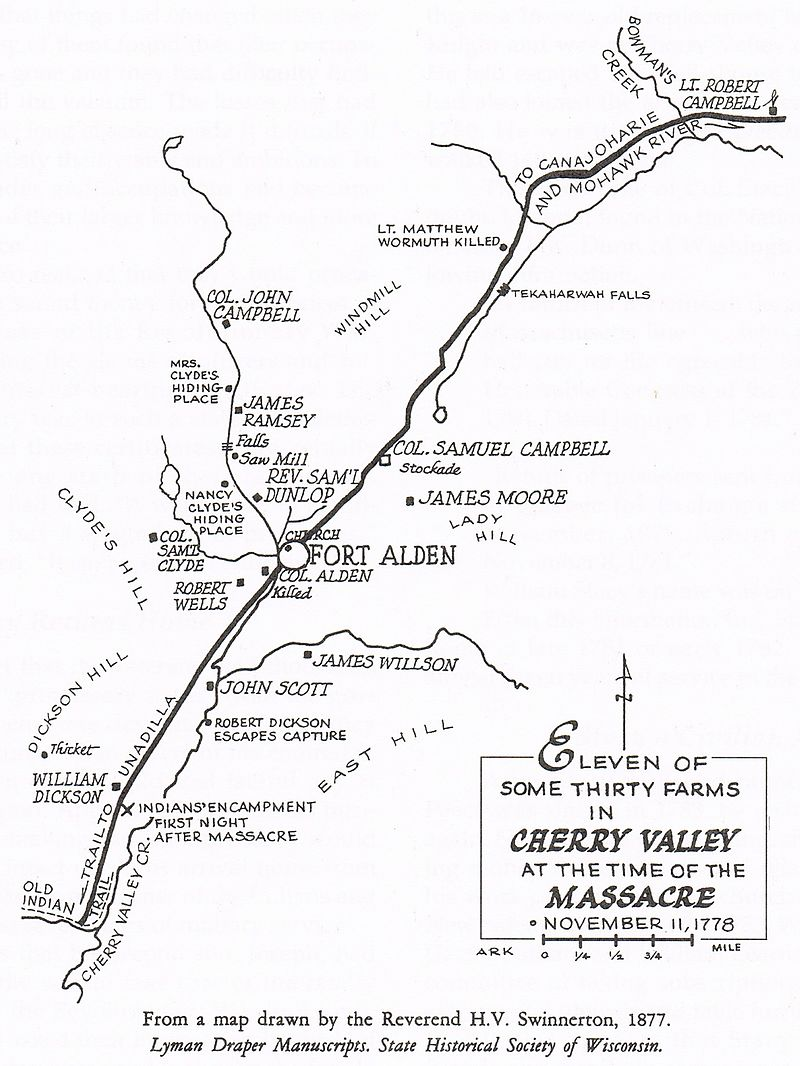
Cherry Valley should stand, not as a memorial to patriotism, but rather as a reminder of mankind’s inhumanity towards man. Because this chapter deals so much with Miskasquamish, RAW’s main American Indian character, it is worth noting that historians are conflicted on how much the loyalists had to do with the civilian massacre at Cherry Valley on November 11, 1778.

The troop that attacked Cherry Valley consisted of loyalists, British soldiers, members of the Seneca, and Mohawk tribes of the Iroquois Nation under the command of loyalist Walter Butler. According to Butler he had little to no control over the indigenous people who were with his group. Historians seem to agree that it was the Seneca members of the raiding party who turned on the civilians. The Seneca’s anger was caused by the destruction and burning of their settlements by American settlers...an eye for an eye. Butler’s command was undermined by conflicts with Joseph Brant, leader of the Mohawk tribesmen. The division between these two leaders allowed for the massacre of 30 civilians, along with 14 soldiers, and Colonel Alden, the American commander of Cherry Valley. Curiously, one survivor of Cherry Valley, a Lieutenant Colonel Stacy says that he was about to be killed but appealed to Brant, indicating that he was a freemason, and Brant had his life spared. Brant would also capture 70 people from the survivors of the initial attack.

The Colonial forces had been warned up to three days before the raid by Oneida allies; however, the commanding officer Colonel Ichabod Alden didn’t take the reports seriously, keeping his command outside of the central fort. That is probably why his name is on the list of casualties of the initial raid. Indeed, the British and Indigenous forces didn’t have the firepower to breach the fort but swept around it, attacking the nearby settlements.

Cherry Valley did more than drive Colonel Muadhen, who thought he’d seen it all, into Bible-babbling catatonia. The colonists were horrified at the massacre and General Washington commissioned the Sullivan Expedition that spent the next year trying to drive the Iroquois completely out of New York. Eighty villages were attacked and razed over the next year by Colonial forces as a part of the Frontier War that raged along the Revolution. An eye for an eye. Funny how we’re not even good, as a species really, at proportionate response and some still believe in that dreadful equation.

Sigismundo, a colonist of the Northwest Territory, is having his own conflict with a native resident. Miskasquamish has pushed Sigismundo towards something of a breaking point; it is appropriate that during their tense conversations they sit by sulphurous water. Alchemically, sulphur represents the “heating” of the work...the rising action. Sulphur is also used in Afro-American Hoodoo to cross, jinx, or banish enemies and obstacles. “I hope you know...this means war.”

Their conversation also seems to play with European/Indigenous relations as well. Sigismundo tells Miskasquamish the story of Christ without identifying him and in the terms of Miskasquamish’s cosmology. Contrast this to the historical missionary efforts to forcefully convert the American Indians and erase their cultural understanding of the universe. Sigismundo also insists that he has the right to live in Ohio because he took the time to build his house there and hasn’t acted aggressively to his new neighbors. Right now, there is a small movement to rename the capital Columbus to something more suitable, like Flavortown. Many Ohioans and the folks in the peanut gallery are upset by this “erasure of history.” I wonder how many of them know where place names like Chillicothe, Cuyahoga, or Ohio came from and what they mean. We are left with the question, to whom does the land belong?

If we consider Wilson’s The Trick Top Hat, which to me seems to be a pretty earnest depiction of his version of a utopian United States, Miskasquamish is probably going to be disappointed in his property dispute. Neighborhoods in The Trick Top Hat are regulated thusly: if a neighbor annoys you by living eccentrically, loudly, outside the Homeowners Associations rules, etc. you may lodge a complaint. Government officials will try to talk with the neighbor, see if they can find them a more appropriate neighborhood- usually to one of the LaGrange floating cities where eccentrics are flocking during the novel. However, if the neighbor chooses to remain and they’re not directly affecting the rest of the neighborhood, there’s fuck all anyone can do about it. So, while Miskasquamish is worried about the moral depreciation of his neighborhood with a Reverser present, well...let’s just say “there goes the neighborhood.”

Miskasquamish’s confusion upon seeing the gun makes sense only at the end of this chapter. His naivety is almost offensive during the sequence as surely a man who had travelled so far during the pre-Revolutionary period and Revolution would have encountered firearms. Sigismundo’s display of the weapon also parallels the ultimate outcome of many colonial-native relationships and the Cherry Valley massacre. Sigismundo’s display of superior technology is troublesome to this reader and reflects the history of the Americas all too well. That said, RAW gives Sigismundo a moral “out” by having Miskasquamish note he never directly threatened his body with the gun...if that is much of an out. Miskasquamish takes this away from Sigismundo’s stories about the Builders and his interactions with the Neapolitan; all the Europeans are mad. Considering history, I’m not sure is Miskasquamish is truly “paranoid.”

Parallel to Seamus’ sickness as witnessing the maraschino-hued carnage of Cherry Valley runs the miraculous recovery of Paddy the Dog back on the Babcock Estates. Considering how Seamus saw himself through the eyes of the English, it is darkly appropriate that there is now a character dubbed “Paddy the Dog” trotting around his old stomping groups. Little Ursula has inherited her mother’s gift and while we see no evidence in the first part of the chapter, her nigh-resurrection of Paddy, who might also be a reference to Joyce’s departed Paddy Dignam, might have a sympathetic effect on Muadhen across the pond.

Miskasquamish returns to Sigismundo dressed as a woman; a reference to some native Tribe’s gender nonconformity and reminiscent of the gender swapping tradition found in shamanic traditions such as the Nat Pwe of Thailand. After appearing to Sigismundo, who asks no questions, they proceed to smoke and travel to strange new worlds.

From Eric: “Some witch music for this chapter. https://youtu.be/Nz5DLO8fclA

Friday, June 26, 2020

Vivaldi's 'Four Seasons'


A Creative Commons recording of The Four Seasons by the Wichita State University Chamber Players. 

Gregory Arnott's excellent Nature's God blog post Monday discusses the history of magick, something I know nothing about, and inspired some great comments. I thought for today's post, I would say something about Antonio Vivaldi's The Four Seasons, mentioned in the chapter Gregory covers. (I had a tough work week, working seven days in a row. On the seventh day, yesterday, I finally read the chapter and then listened to a Trevor Pinnock recording of The Four Seasons.)

As Maria falls asleep, she thinks of the "thirteen Weeks in each of the four Seasons, Vivaldi's Four Seasons music running through her head, and the thirteen at the Last Supper, and the sun, which is One, moving in eternal circle through the 12 Houses, one plus 12 being thirteen..."

I would point out that the structure of Vivaldi's work also fits the "one plus 12 being thirteen" that Maria thinks about. It's a work about the cycle of one year, but it consists of 12 movements, three for each season. (Three movements are the normal structure for a concerto, and The Four Seasons is a collection of four violin concertos.)

The Four Seasons itself has an amazing history. Vivaldi, who died in 1741, was pretty much forgotten for more than 150 years (it's not really likely Maria would have known his music) but eventually The Four Seasons underwent an amazing revival. Wikipedia cites the numbers: "The World's Encyclopedia of Recorded Music in 1952 cites only two recordings of The Four Seasons – by Molinari and Kaufman. By 2011, approximately 1,000 different recorded versions have been made since Campoli's in 1939."

If you have a library card, you can likely to listen to dozens of recordings on the Freegal or Hoopla Digital streaming music services. Or you can listen to the recording by John Harrison and the Wichita State University Chamber Players, released to everyone under a Creative Commons license.


Monday, June 22, 2020

Chapter 8, Nature's God reading group


Week Eight: Chapter Eight “My Lady Greensleeves” pg. 139-147 Hilaritas Press edition

By Gregory Arnott
Special guest blogger

After asking Oz for confirmation, I am confident in saying that the structure of this chapter is taken from Crowley’s Liber Aleph. This is ironic for a chapter dealing explicitly with Maria’s initiation into a Wiccan coven as Oz pointed out that Liber Aleph was written as a series of letters from father to son. (Specifically from Crowley to Charles Stansfeld Jones, better known as Frater Achad, his “magical son.”) The intermittent Latin titles are used throughout Liber Aleph and Robert Anton Wilson uses the same device in Masks of the Illuminati. The biblical phrase for He is like a refiner’s fire also appears prominently in the earlier novel. The tone of this chapter, specifically the ecclesiastic sounding “yea, the…” repetition, is also taken from Crowley’s Holy Texts.

Here is my Google-assisted hack-job translation of the titles, considering the action that happens following each title I believe my unwieldy versions make some sense:

The Hardening of Man
On the Danger of Alternative Love
On the Four Equal Virtues
The Female Formula
The Crazy Love
The Great Works of the Microcosmic Star of Which there is Four
The Secret Horror
The Delicate Powers of Art and Love
Hold, Illegitimate Vigor

The coven that Maria is initiated into is more-or-less an anachronism with the language taken from post-Gardnerian Wicca. Bear with me and for any neo-pagans who might be reading, I’m not trying to be offensive.

The fact that the language is so strongly influenced by Crowley’s writings is appropriate. As Kenneth Grant and other writers have related, during the Twilight of the Magicians, the lingering years of the two great English occultists of the 20th century, namely Aleister Crowley and Austin Osman Spare, an eccentric customs-officer named Gerald Gardner was lurking around in their company.

Gardner, who follows in the grand tradition of magic by being a goddamn liar, claimed that his Wiccan practices were derived from a coven that had kept pre-Christian religion alive. He had mostly made up his practices from stitching together elements of the, now discredited, anthropological studies of Margaret Murray about a supposed witch-cult, Freemasonry, and ceremonial magic. In fact, the three degree ceremonies presented by Gardner for the purpose of Wicca were penned by, wait for it....Aleister Crowley.

Curiously, RAW’s use of terms such as “women’s mysteries” and the “burning times” doesn’t appear to be ironic. I believe this is curious when we consider how much hostility towards some late-twentieth century academic models of femininity RAW displayed in his writings, especially since both of those terms are complete, artless bullshit. The concept of “women’s mysteries” bastardized the study of pre-modern religion and tried to replace the complex mythological development of goddesses such as Demeter, Sekmet, Selene, and Isis into a group of gentle Montessori teachers whose feminist, pre-agricultural utopia was ruined by the arrival of phallic gods. Given that there is nary a drop of historical evidence for these gentle matriarchal societies and that the historical record of how these goddesses were apprised and worshipped is much more ambiguous didn’t stop the believers from trying to rewrite history. (Though Crowley doesn’t spend the time moralizing like later witches, it is worth noting that according to his structure of history the first Aeon was matriarchal and was subsumed by the agricultural-phallic second Aeon. We are now in the third Aeon where the focus is on the development of the complete person, the child, and individual sexual dimorphism seems to be the rule of the day.) Perhaps even more annoying is the use of the idea of “the burning times” which, forgive me, is such a stupid fucking concept my ears bleed anytime I hear someone utter it.

There was no “burning time” that modern covens suffered through and survived underground as they watched legions of innocent believers of the “old religion” burn at the stake. Historical evidence, known as far back as the turn of the twentieth, indicates that pretty much every witch hunt was either a power-play by ruling/ecclesiastic authorities or the result of hysteria. The excellent Swedish film Haxan: Witchcraft Through the Ages presents a compelling and intelligent examination of these phenomena- even better, watch the version with William S. Burroughs narrating.

In conclusion, this chapter is made up, not that big of a revelation in a novel, almost whole cloth from twentieth century notions that couldn’t have existed because ceremonial magic hadn’t come along to create them yet. The notion of the four elements was around at the time but the codification of what those elements mean “spiritually” wasn’t wholly accomplished until a bunch of old Rosicrucians got together to combine the works of Paracelsus, Agrippa, the Qabalah, and Tarot into one system of magic. A study of the Tarot will reveal how many of our romantic notions (for example, that the modern playing deck is derived from the cards smuggled from ancient Egypt) are entirely erroneous. Indeed, before Moina and MacGregor Mathers codified the Qabalah to to the Tarot, building on the work of Eliphas Levi, any use of it for divination or meditation would have been no more sophisticated than basic cartomancy. Even the pentagram, today used as a symbol of neo-paganism, wasn’t imbued with its microcosmic significance until the Golden Dawn came along to create the Lesser Ritual of the Pentagram and their study materials.

Yes, there are examples of the four elements, the four apostles, the four faces of Ezekiel’s angels throughout history, but to say that there was a working system of knowledge, linked with similarly initiated members throughout history is as romantic and ahistorical a notion as the existence of Sigismundo Celine, Old Kyte, and Maria Babcock. And blimey, I haven’t talked about anything that actually happens in the chapter -- I guess that’s a sign that it’s time for me to get to bed before I become any crankier and end up with a crudely fashioned crystal tipped wand through my throat or a mail order athame through the heart.

The stuff about the I Ching is mostly accurate in that Leibniz was obsessed with the similarities between the Hexagrams and his notions of binomial numbers and Calculus, however it would still be almost a century before writers began to connect the I Ching to Western Mysticism. The pioneer of this connection? You guessed it, Aleister Crowley.

From Eric: A soundtrack for our “Study-Group or Coven or whatever this was called” (Nature’s God, pg. 142). https://youtu.be/nwn2zd8ROlQ 

My own musical offering: https://youtu.be/zE4yQxRvWGU


Monday, June 15, 2020

Nature's God reading group, Chapter 7


Sigismundo in the wilderness. (Image by Bobby Campbell. Used by permission, more information about Bobby's work here.) 

Week Seven: Chapter Seven “The Wilderness Diary of Sigismundo Celine” pg. 113-138 Hilaritas Press edition


By Gregory Arnott
Special guest blogger

I’m not up to doing a blow by blow commentary on this chapter, the prospect is too daunting. As Bobby Campbell said when we began the reading group “a shocking amount of the most virulent RAW quotes come from Sigismundo's wilderness journal.” There’s a lot herein and much of it is best contemplated upon- preferably, in some sort of silence.

My favorite excerpt is one of the more famous ones: “You are precisely as big as what you love and precisely as big as what you allow to annoy you.” As someone who allows themselves to get annoyed way too often, I can testify that this is true, or seems to be to me.

Re: fleas

“I found that my long abstinence from magical practices had injured my powers. I resumed elementary drill and soon got back to my old form. For one thing, my protection against mosquitoes had worn off. I spent a night motionless, offering my body to them and concentrating on the thought that they were equally divine with myself. I forced myself to love them, so that in union with them the apparent differences between us might vanish in   ecstasy. I compelled my body to accept, to welcome and even to long for their bites, as being acts of love whereby I nourished their lives. In the morning, though badly bitten all over, there was no inflammation whatever; and from that time on they never bit me at all.

I soon recovered the powers of Pratyahara and Dharana. My mind became still; the impact of impressions ceased to obsess me, I became free of the illusion of the reality of material things. All events became equally indifferent, exquisite phrases in an eternal symphony. (Imagine listening to Beethoven with the prepossession that C is a good note and F a bad one; yet this is exactly the stand point from which all uninitiates contemplate the universe. Obviously, they miss the music.)”

The Confessions of Aleister Crowley

From Eric Wagner: "This seems good for the solstice." https://www.youtube.com/watch?v=KY1p-FmjT1M&feature=youtu.be


Tuesday, June 9, 2020

Nature's God, Chapter Six (Part Two)


Memorial for Chevalier de la Barre

By Gregory Arnott
Special guest blogger

As the historical personalities are introduced throughout the chapter RAW often lists their birthdate and contemporary positions in society. (John Hancock’s is incomplete- aside from being a smuggler he was also a famous lush before signing the Declaration of Independence.) To your humble guide (b. 1990, sun in Gemini, moon is Aries, Capricorn rising), this somewhat reductionary approach serves a purpose as we watch their actions and their opposite and opposing actions throughout the chapter.

Through Seamus’ speeches to his men we see how Thomas Jefferson (33 year old planter, attorney, architect) and Thomas Paine (39 year old teacher, sailor, customs agent) became the Great Architects of the American Experiment. Colonel Muadhen’s Irish flavoring speaks to how we all have our own ideas of how America was shaped, usually in favor of our ancestors. Muadhen’s experiences also ground the romanticism of the Revolution and the high ideals of the Founders in the lived experience of the men who somehow won the war. I recently read a Bertolt Brecht poem that asked variations of the question “Did Caesar conquer Gaul alone?” These “great men” direct the course of history, which as Muadhen’s “Sinister Italian” noted, is not usually very merciful to those who make it. This point is hammered home in Muadhen’s final scene where he tries to rouse his men after victory at Monmouth- despite the patriotic fervor and winning the day, his speech is drowned out by the screams of wounded and dying soldiers.

Across the Atlantic we observe John Adams crusading around the Continent to secure funds for the Colonist’s cause and Benjamin Franklin having a grand time in Gay Paris. Adams seems to be a model of Wilson’s “right man” who is able to bend the world to his will by sheer virtue of believing that his model of the world is the only legitimate model. It seems like a missed opportunity, especially considering the highlights of the mutual career of the Batty Babcocks, that Wilson didn’t include any of Adams’ correspondence with his wife Abigail- a woman who wielded a great amount of influence for her time. Franklin meanwhile entertains many different ladies while waiting for King Louis XVI’s decision. During his time in Paris he is brought face to face with the most famous heretic of the age.

Voltaire, as Wilson notes, was nowhere near as controversial when he returned from his Swiss exile. Rather than imagining that this change is because of acceptance of his ideas, the reader should be aware that this is because most people didn’t particularly care about his ideas anymore. Once the most potent thinker in the world, Voltaire would be cast aside as a curiosity by most of the world. Regrettably, most of the world would also abandon Voltaire to textbooks and literature surveys and, as noted in the beginning of the chapter, most of the Enlightenment ideals that influenced America did not come from the French philosophes but rather the milquetoast philosophy of John Locke. If the United States had been more influenced by Voltaire, Diderot, and Rousseau I believe our country would look a lot better right now. But we didn’t and to our disadvantage most of what the world took from the Enlightenment was a sense of being better off than we were without the rigorous skepticism and humanism that grounded the philosophy of the time.

As Voltaire makes his way into Paris we are reminded of the case of Chevalier Francois-Jean de la Barre, whose execution was observed by Sigismundo, his father, and Herr Zoessor in The Earth Will Shake. Because his writings were used as evidence of La Barre’s atheism (he was accused of desecrating a cross) Voltaire did take a great interest in the case and did as much as he could to fan outrage over the incident. This account points out that Voltaire’s letters on the subject of La Barre are not great historical documents as they were written as polemics. Today the date of La Barre’s execution, July 1st, is celebrated in France as “Chevalier La Barre Day,” a holiday for those who oppose religious tyranny. In light of Reichsfuhrer Barr’s insidious integralism I think we’ll be celebrating this year. Honestly, I just can’t believe we’re still dealing with the Roman shtik in 2020.

But Voltaire’s dinner conversation after his initiation as an Entered Apprentice would indicate that I shouldn’t be in disbelief. It is fascinating to read Franklin, Voltaire, and Condorcet’s speculative conversation and predictions in light of the past 250 years of history; one of my favorite parts of The Historical Illuminatus Chronicles is how RAW delivers this type of historical voyeurism throughout the three books. Voltaire, despite the pageantry of being initiated as an Entered Apprentice, is still on his way out the door and doesn’t appreciate what he sees in the room, Franklin has an insouciant but generally hopeful attitude, while it is left for the Marquis de Condorcet to rhapsodize about the world of tomorrow.

Condorcet was as optimistic, good, and talented as Wilson portrays him; he was beloved of the French people and considered an embodiment of the Enlightenment. He wrote an early treatise against slavery and was later an early member of the Revolutionary movement which he hoped would lead to a rational society. Like many other philosophes he was gravely disappointed in the results and later had a warrant issued for his arrest by one of the shifting governing councils. The sentiments and ideas that Condorcet relates in this chapter are taken from his work Sketch for the Historical Picture of the Progress of the Human Spirit which was published posthumously. Condorcet truly believed that scientific progress would lead to equality, liberty, and fraternity; what makes this vision of Utopia especially poignant is that he wrote it while in hiding from the authorities. He was captured and jailed- two days later he was found dead in his cell. He either committed suicide with smuggled poison or was murdered extrajudicially as the people would not have stood for him to have been executed.

His proposed future was drastically altered by a force he might have been unaware of but Wilson makes sure to note: Adam Smith’s problem child capitalism shows up to make sure progress will follow wealth instead of knowledge. Weishaupt's machinations could be seen as a furthering of concentration of power muddled in conspiracy and guesswork. There are always snakes in the garden. For invisible hands and heads these forces leave magnificently obvious signs of their sweeping scythes and strangling. As MacGregor’s simp Brodie-Innes said, “it doesn’t matter if the Secret Chiefs exist, merely that the world operates as if they do.” Too bad the Secret Chiefs ended up emulating Dennis Hooper’s Frank Booth instead of Trismegistus.

One gardener who goes through extraordinarily elaborate pains to prove the existence of the snakes is another Marquis, this one Divine and imprisoned. As I have noted before, de Sade is often still misunderstood as a madman, devil, or pervert, while he may have been all of these he was also privy to a sanity that would break most people entirely. De Sade’s screed against the Powers That Be is just as relevant and damning today as it was when he was stuffing the manuscript in a crack in the Bastille’s wall. Paolini’s excellent Salo is a prime example of the material’s ability to shock and condemn- unsurprisingly, de Sade’s life isn’t going to get any easier and his masterpiece won’t be published until after his death.

And we have one more snake in the guise of Dr. Fritz Cyprus who proposes that the Dark Ages were just lovely and that the Church really should be in charge of society. (Cyprus, a malignant German, might be an ancestor of Professor Hanfkopf from The Widow’s Son.) Wilson points out the dark side of Romanticism, to elaborate; while the works of the pre-Raphaelite artists were astounding they did introduce a strain of Catholicism and regressivism into English Decadence that would lead to it being quite a bit more fatal than the French version. The connection between antirationalism and fascism is incredibly relevant to today as we watch a large part of the country cheer a wanna-be dictator on to further insanity. The chapter closes with another antirational figure who just thirty years ago, despite lacking a penis, did all she could to set back progress and equity.

Away from all of this a Neapolitan musician is sitting under a tree meditating in Ohio. We’ll sample the fruits of making one’s mind into a mirror next week as we begin Book Two of Nature’s God with “The Wilderness Diary of Sigismundo Celine.”

From Eric: “ I thought this would make a nice soundtrack for this chapter. https://youtu.be/j1EI4kwr1kw

My own musical offering this week, for Lady Maria Babcock/Sarah Beckersniff, the world would have been better would you have lived, dove sta memoria: https://youtu.be/vZtkVj3JPaw

Monday, June 8, 2020

Nature's God, Chapter 6 (Part One)


From Fanny Hill; or, The Memoirs of a Woman of Pleasure (illustrated by Franz von Bayros)


Nature’s God Week Six: Marquis de Sade and Other Libertines (pg. 71-108 Hilaritas edition)

By Gregory Arnott
Special guest blogger

Like the end of the separate Parts of The Earth Will Shake and The Widow’s Son, Book One of Nature’s God closes with a panorama of the historical events that surround our four protagonists. This gives the book an epic scope and allows RAW to make his riff/commentary on history and progress. I doubt that I need to point this out to any of us but this chapter is of course written somewhat in the style of “The Wandering Rocks” from Joyce’s Ulysses. (I say somewhat as, despite the headlines, Wilson doesn’t really ape newspaper writing and instead writes in his regular, suggestive style.)

Chapter 6 covers five major story lines, in my opinion (or I’m going to make an arbitrary division because it would be incredibly difficult to write about all this otherwise): the publication of A Moistness in the Wind, the efforts of the men we now call the Founding Fathers to further the American Revolution- especially the pugnaciously honest and self-assured John Adams, Colonel Muadhen’s direct experience of military service and lionizing mortals, the return of Voltaire to Paris which is juxtaposed with the imprisonment of de Sade, and Sigismundo in Ohio meditating and experiencing all phenomena as real in some sense, unreal in some sense, meaningless in some sense, real and meaningless in some sense, unreal and meaningless in some sense, and real and unreal and meaningless in some sense. And this paragraph is made of two sentences.

Maria’s rather innocuous letter to London Gazette and the actions of Weskit Fitzloosely, while fictional, reflects the complicated history of the press in England. It was often the actions of drunks and pornographers that pushed the borders of decency and championed true freedom of the press. For example; The Yellow Book was the most popular periodical in 1890s London, it published the artwork of Aubrey Beardsley and John Singer Sargent, contributors included Ernest Dowson, W.B. Yeats, Max Beerbohm, and Baron Corvo. Yet, when Oscar Wilde was brought to trial he carried a yellow bound book with him- most likely a copy of Huysmans or Pierre Louys, and although Wilde had never contributed to The Yellow Book, because Beardsley’s (who detested and even feared Wilde personally) sumptuous illustrations had graced both Wilde’s Salome and The Yellow Book the periodical was inextricably linked to deviance, buggery, and indecency. A valuable publication was snuffed out. Luckily Arthur Symons is in the corner, rubbing the shoulders of his prize-fighting pornographer Leornard Smithers who fearlessly puts out The Savoy. Smither’s provides work to the members of the Decadence Movement when other publishers fear Victorian prudishness and public opinion and The Savoy remains to this day a jewel case of gemlike parts of English prose and art. A more contemporaneous example, in relation to Maria’s publication, would be the downright humorous publication of John Cleland’s Fanny Hill; or, The Memoirs of a Woman of Pleasure. Cleland wrote his pornographic masterpiece while in debtors prison and promptly found himself back before a judge after the initial publication of his manuscript. There Cleland whittled and wailed his way out of a conviction and according to one biographer was rewarded a pension by the court to prevent further writing. Meanwhile, Fanny Hill went merrily along being published by the pirate press by the boatload- no one really knew what to do about it.

Maria, under her borrowed-from-Jonathan-Swift nom de plume of Beckersniff, ironically asks if anyone more civilized than “the Methodists, the Howlers, and the Ranters” believe in God as a physical being versus a spiritual concept. I say ironic since it was the Protestant dissenters who really began the underground printing tradition in England. Going back to Tyndale’s Bible in the early sixteenth century and continuing to John Bunyan’s writings (written while imprisoned for his preaching more often than not) in the late seventeenth century and beyond to Blake in the eighteenth, Protestant religious nutters have had a lot to do with freedom of the press. This is something I’m sure most of today’s fundamentalists would regret if any of them were literate or capable of having even the most rudimentary grasp of history/reality. Oh well- ignorance and dragging the world back to the Dark Ages are bliss, as they say.

We are told that, like Fanny Hill, Maria’s “little volume” proliferated in pirate editions and that seven copies remain in libraries around the world today. Two of the libraries are interesting: one is the collection of Gershon Legman. Legman was a folklorist who specialized in erotica and wrote The Rationale of the Dirty Joke, a book the author of Playboy’s Book of Forbidden Words would surely have appreciated. The second library is of course Miskatonic University. The subject matter of A Moistness in the Wind, as I mentioned before, harkens back to Wilson’s first published essay in Krassner’s The Realist. The material in the excerpts seems to be an anachronistic rewrite of the original essay with some of Hargrave Jennings material thrown in for extra flavor. (In the spirit of Wilkes I will relate that my wife pointed out a few evenings ago that there seems to be no purer happiness than that of a man who is having his penis touched. I couldn’t argue in most circumstances, but she’s never had to endure that supremely awkward part of a physical.)


Tuesday, June 2, 2020

Nature's God, Chapter Five, Part Two


Traditional depiction of Washington at Valley Forge

Week Five: Chapter 5 “The Light Sings Eternal” (pg. 59-70 Hilaritas edition) Part II

By Gregory Arnott
Special guest blogger

In Chapter Five we immediately encounter George Washington, toking peacefully in his tent. This has been brought up in the comments, previous posts, and in Eric’s Introduction to this volume but the other prominent example of a stoned Founding Father is found in Thomas Pynchon’s Mason & Dixon. (Another pop culture reference to the patriotic pastime of pot smoking comes from The Firesign Theater’s Everything You Know is Wrong which RAW references at the beginning of Cosmic Trigger.)

In Pynchon’s novel Washington is not presented on the battlefield but in the years before at his home in Mt. Vernon- like Benjamin Franklin, who appears earlier, there is the typical Pynchonesque-shiftiness to the character, and his appearance is used to combine humor, drugs, and social dissection. It is Dixon, who had spent time in South Africa observing the Transit of Venus, who recognizes the scent after Washington has spoken to a slave churlishly, upsetting the surveyor. Washington, to smooth things over, begins to pass the pipe.

The character who makes this scene fascinating is Gershom, a black Jew enslaved by Washington. Although he is told to go prepare hog jowls for the white gentlemen’s oncoming munchies, he instead takes the pipe and joins in their conversation. As the foursome consume more cannabis, Gershom--whose name is perhaps a reference to that most impressive academic scholar of Kabbalah, Gershom Scholem--seems to take the reins of the conversation. The scene culminates with Martha, who “smelled the Smoak” and figured the boys would be hungry, bringing in a plate of desserts out of Scooby Doo.

Dixon’s discomfort with Washington mirrors his earlier disgust with the racist tyranny in South Africa and clearly links it to the depravity of the Colonies. The presence of Gershom gives a place in the circle with the three white dudes who are generally celebrated by history, further subverting the scene Pynchon has created.

While Pynchon may have read Nature’s God, RAW points out in the Appendix of Illuminatus! and in Sex, Drugs, and Magick that Washington’s enthusiasm for cannabis is on the historic record. And further study indicates that he was growing it for “medicinal” purposes and was influential in the spread of hemp across the Americas.

During their smoke sesh Washington gets a little spooky, as one is wont to do, and begins discussing plates with mysterious inscriptions, unearthed in the distant frontier. The narrator of the novel, Reverend Cherrycoke, steps in to note: “[t]here remains a residue of Belief, out to the Westward, that the mere presence of Glyphs and Signs can produce magickal Effects,- for the essence of Magic is the power of small Magickal Words, to work enormous physical Wonders.” This connection between mystery and the (then) West is present in both Mason & Dixon and Nature’s God and, as I noted earlier, ties into the traditional American theme of wilderness as the land of subconscious wonders/terrors.

James Moon is promoted to Colonel by Washington after he refuses to recant that he has witnessed a rock fall from the sky. Later, when he is transformed back to Seamus Muadhen after his out of body experience, Washington confides in him that he had encountered a strange man in a glowing craft who predicted the future in detail.

I could find no mention of this exact incident but it does sound similar to the encounters with sky people documented by writers such as John Keel and Jacques Vallee. I believe that this is an extrapolation of a story that I imagine many of us encountered in storybooks: Washington’s Vision at Valley Forge.

The general account goes that Washington was overheard by a young man telling an officer about praying in the woods near Valley Forge when an angel appeared before him and accurately predicted his success, presidency, and events of the country's first few decades. This is usually reduced to a “see big historical guy pray good have faith” gibberish but it actually began as a piece of Civil War propaganda. The tale was presented by “99 year old” Anthony Sherman who related it to a journalist, Charles Wesley Alexander, who published the story in 1861. Naturally, this is all bullshit and Alexander penned it himself to bolster the Union during the fledgling year of America’s bloodiest conflict.

I found an account from the Roswell Daily Register that recounted the story above along with another that claimed Washington would occasionally get advice and encouragement from “little green men” on the frontier during the Revolution. The story goes on to say that Washington believed them to be an advanced, eccentric Indigenous people. If anyone knows of other stories about Washington encountering the uncanny I would love to hear them or be pointed in the right direction.

Before Seamus meets with Washington he is convalescing with the wounded Marquis de Lafayette who is very bothered by the Quakers’ speech patterns. I have two things I’d like to say about the Marquis’ predicament: firstly, that his fear that he was in a British prison and that they were trying to drive him mad is a rather blatant reference to what had happened to Sigismundo at the hands of some nefarious parts of the Marquis’ own government. My second point isn’t so much of a point but a personal anecdote about why I was able to perfectly picture the look on Lafayette’s face. This is because of a Christmas dinner I had with my Uncle’s mother’s relatives who were from Germany and exclusively German. At the time my maternal grandmother, who was still alive but had Alzheimer’s, was under my care most of the time during weekends and holidays and was well enough to get out of the house. While my family talked to the relatives through my Uncle’s mother, I tried to be game by loudly mispronouncing German authors/beers and smiling and nodding with them when they would correct or repeat the name. After a while I looked across the table at my grandmother who was sitting, her first fork of food halfway to her mouth, in wide-eyed confusion at what I’m sure seemed like a moment when the world stopped making any sense. I did love her very much.

Lafayette also muses on Voltaire’s Micromegas, an excellent short story that is often pointed to as an early example of science fiction. Micromegas is about a giant being from a planet orbiting Sirius who travels about the galaxy until he comes to Saturn. There he meets another gigantic being, although smaller than Micromegas, with whom he is able to converse about many subjects. Eventually the two come to Earth where they wade in our Oceans and decide the planet must be uninhabited before meeting a boatful of scientists and philosophers to whom Micromegas promises a book answering all of mankind’s questions. The book is found to be blank after his departure. Fitting and quite like some “real” encounters people have claimed to have had with space beings.

To return to James, he’s shot and split into a trinity of selves: a body, James Moon, and the old Seamus Muadhen. The truth of masks is transcended and James is cast aside as an imposter to please the British. Oppression runs deep and, aside from nationality/race, this dialogue could be replaced with a variety of characters from a variety of backgrounds during a variety of times. In light of yesterday’s first part of this post I will close with the following:

“Once we were all stars and we’ve been making Punch and Judy puppets of ourselves.” 


Monday, June 1, 2020

Nature's God reading group, Chapter 5


Chicago 1968 (But does the year actually matter?)

Week Five: Chapter 5 “The Light Sings Eternal” (pg. 59-70 Hilaritas edition) 

By Gregory Arnott
Special guest blogger


Prologue: An Editorial 

When one’s friends hate each other
            how can there be peace in the world?
Their asperities diverted me in my green time.
A blown husk that is finished
            but the light sings eternal
a pale flare over marshes
                where the salt hay whispers to tide’s change
Time, space,
          neither life nor death is the answer.
And of man seeking good,
            doing evil.
In meiner Heimat
                   where the dead walked
                              and the living were made of cardboard.- from Canto CXV by Ezra Pound 

The excerpt from which this chapter’s title is taken from seems appropriate. Canto CXV was the penultimate complete canto written by Pound -- it was authored with the final group of cantos after he had been released from the mental asylum to live with his daughter. It dwells, like most of the post-asylum cantos, on hatred and homecoming -- according to Wikipedia these cantos are heavily influenced by Voltaire, who appears indirectly in the chapter at hand, bon mot about one of his critics, Freron- “I hate no one, even Freron.” I think that themes of homecoming and hatred are especially relevant after the past week. When we consider these lines were inscribed by a fascist--who told Ginsberg (a gay Jew that loved everything, even him, despite his puerile actions) that he regretted his “stupid, suburban prejudice” of anti-Semitism, the convolution reflects today. 


What the fuck are we to make of all this? Yesterday I cried as I watched humans take off again from Cape Canaveral in a mission that begins our push to return to the stars. At the same time the country from which they took off heaved with pain and anger after four policemen were caught on video shamelessly lynching a black man. I cried very different tears when I saw that video. 

100,000 dead from COVID-19 in the United States and now the streets of many cities are crowded with shouting protestors. Perhaps, like Trump’s beloved hydroxychloroquine/bleach cocktail, pepper spray can prevent the spread of the virus. (That would at least explain why a police officer pulled down the medical mask of a stationary protestor and sprayed some into his face.) The blood of the past turns to action as it comes back in a desperate homecoming, beaten back by those who spilled it; as parts of the country are engulfed in flames, another America looks to the stars. So many chickens, so many roosts. 

Haven’t we done this before? I mean, this script seems to be straight out of 1969 when Wilson and Shea were typing up fragments of the Playboy Forum’s rejected letters into Illuminatus!. A year earlier Wilson had been in the streets and had to run and duck from fascists poorly disguised as the law dispensing generous amounts of tear gas and blunt force trauma to the people. We landed a man on the Moon. But did we learn anything? 

Personally, I don’t like the fact that goofy, anti-union billionaires and the current administration are leading the push into Earth’s orbit and beyond- I also don’t like that the initial NASA program was riddled with Nazis. Now the country is riddled with them. Jesus Christ- this is a mess. But I cried tears of joy and grinned when the rocket successfully landed on a drone ship named after one of the AI “minds” in Iain Banks’ Culture series. 

Before the launch I remembered those who I did admire who had fought against Impossibility itself to transform fiction into reality: Sergei Korolev-Chief Designer and death defier, Katherine Johnson- West Virginian, black woman, and genius, and Jack Parsons- the Thelemite magician, counter-culture revolutionary who insisted that his boarding house be inhabited only with “atheists and communists” during the 40s. Before the launch I read Crowley’s Hymn to Pan aloud with eleven seconds to spare and felt some of the excitement, an infinitesimally small amount comparatively, that Parsons must have felt when he stomped and recited the poem before rocket launches. 

You’ll forgive me if this seems out of place- it isn’t and these are matters that need to be discussed in connection with a chapter about the struggle to begin the American Experiment and oppressed people forced apart into two souls. A chapter where inoculation, the forerunner of vaccination, is brought up and a fabricated vision with a curious history pops up, further fictionalized by our gnomic author. A chapter about a massive, mythical man who was a goddamn slave owner and knew what he was doing enough to be goddamned ashamed of it and didn’t stop owning humans during his lifetime. And now we’re here, yet again. I’ll try to explain what I see as Robert Anton Wilson’s Magic Pop-Up Theatre of the Moment presently; it unfolds In meiner Heimat, my own country. 

“"I grant all you say," said Cacambo, "but we have still two sheep remaining, with more treasure than the King of Spain will ever have; and I see a town which I take to be Surinam, belonging to the Dutch. We are at the end of all our troubles, and at the beginning of happiness."

As they drew near the town, they saw a negro stretched upon the ground, with only one moiety of his clothes, that is, of his blue linen drawers; the poor man had lost his left leg and his right hand.

"Good God!" said Candide in Dutch, "what art thou doing there, friend, in that shocking condition?"

"I am waiting for my master, Mynheer Vanderdendur, the famous merchant," answered the negro.

"Was it Mynheer Vanderdendur," said Candide, "that treated thee thus?"

"Yes, sir," said the negro, "it is the custom. They give us a pair of linen drawers for our whole garment twice a year. When we work at the sugar-canes, and the mill snatches hold of a finger, they cut off the hand; and when we attempt to run away, they cut off the leg; both cases have happened to me. This is the price at which you eat sugar in Europe. Yet when my mother sold me for ten patagons[20] on the coast of Guinea, she said to me: 'My dear child, bless our fetiches, adore them for ever; they will make thee live happily; thou hast the honour of being[Pg 91] the slave of our lords, the whites, which is making the fortune of thy father and mother.' Alas! I know not whether I have made their fortunes; this I know, that they have not made mine. Dogs, monkeys, and parrots are a thousand times less wretched than I. The Dutch fetiches, who have converted me, declare every Sunday that we are all of us children of Adam—blacks as well as whites. I am not a genealogist, but if these preachers tell truth, we are all second cousins. Now, you must agree, that it is impossible to treat one's relations in a more barbarous manner."

"Oh, Pangloss!" cried Candide, "thou hadst not guessed at this abomination; it is the end. I must at last renounce thy optimism."

"What is this optimism?" said Cacambo.

"Alas!" said Candide, "it is the madness of maintaining that everything is right when it is wrong."

Looking at the negro, he shed tears, and weeping, he entered Surinam.” -Francois Marie Arouet, Candide; or, Optimism  (1759) 

“I can’t breathe.” George Floyd (2020)

From Eric Wagner: "This week’s reading refers to Sirius, so I have chosen one of my favorite albums, Dogon A. D. by Julius Hemphill." https://www.youtube.com/watch?v=hWkma6Uzc0w