Robert Anton Wilson and Robert Shea. Blog, Internet resources, online reading groups, articles and interviews, Illuminatus! info.

Showing posts with label Tale of the Tribe. Show all posts

Saturday, March 29, 2025

New interview with Steve "Fly" Pratt


Steve's album for the Tales of Illuminatus project, available on Bandcamp. Also, see my interview. 

R.U. Sirius interviews Steve "Fly" Pratt about his use of AI in making music. Here's the first question and answer of the Mindplex magazine interview:

RU Sirius: How do you view your creative project (in the broadest lifelong sense) as a process that benefits from integrating current AI systems?

Steve Fly: The latest iteration of my quarter-century (and counting) of research into Robert Anton Wilson’s Tale of the Tribe is a collaboration using some AI tools. Tale of The Tribe is a mountain range whose size and scope requires training to traverse, hill-climbing toward coherence. So far I’ve produced over 65 stanzas with corresponding audio. The first iteration is structured on 60 stanzas to represent the 60 vertices of the Buckminsterfullerene. This is prompted from a line in Ezra Pound’s Cantos “buckie has gone in for structure.” The structure of the poem/album is a tribute to Buckminster Fuller, whom RAW admired and studied with, and it snugly sits as one of the 13 primary inspirations in the way RAW conceived/perceived the universe.

These first 60 stanzas are a proof of concept, to be built on in the next iteration. The goal is for each stanza to also function as a concept for a new core ontology, the totality of the 60 stanzas. As Ben put it: “an overlapping yet somewhat diverse set of perspectives on the core ontological concept”.

More here. 

Monday, April 3, 2023

R. Michael Johnson's excellent essay for the new 'TSOG'


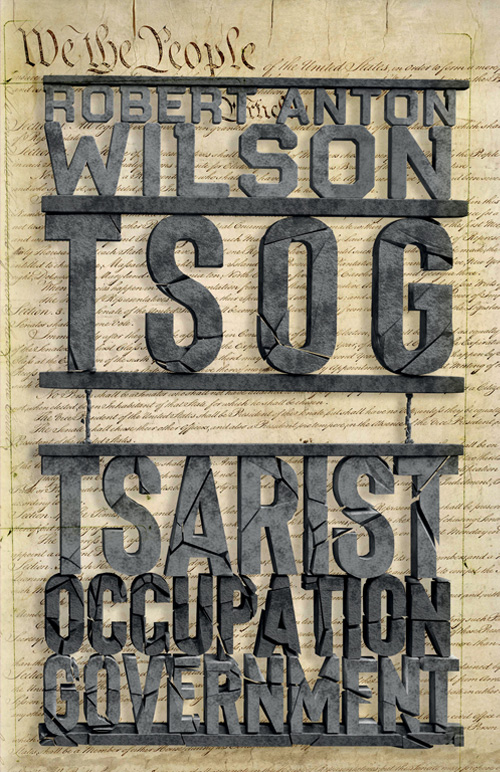
I wasn't really sure I was going to buy the Hilaritas Press edition of TSOG: The Thing That Ate the Constitution and Other Everyday Monsters, as I already has the New Falcon edition. What tipped me into making the purchase was the additional pieces by Bobby Campbell, Steve Pratt and R. Michael Johnson.

All of these guys step up to the plate and deliver. Bobby's piece is about the title. I agreed with all of his comments. Steve talks about how TSOG is a favorite of his among Robert Anton Wilson's works. This might be a good time to mention Steve's book,   Fly On The Tale of the Tribe: A Rollercoaster Ride With Robert Anton Wilson, which discusses the unfinished RAW book outlined at the end of RAW.

And then there is R. Michael Johnson's piece, "Notes on Wilson, Vico, Language and Class Warfare," a long essay. I learned a lot about Vico and RAW's attitudes toward class, but also learned about other points in RAW's writing. 

Michael has a deep familiarity with the writings of Robert Anton Wilson (he once told me that he reads Wilson every day), but as his piece makes clear, he also has carefully read the writers who influenced Wilson. (Eric Wagner has nicknamed Michael "Dr. Johnson" because of his erudition). As a result, when Michael offers an opinion about an aspect of Wilson's writing, he often seems authoritative. 

A couple of examples: Michael mentions Alan Watts' remark that the Roman Empire never fell, and that claiming otherwise was the "biggest blunder" of historians. I have never felt I really understood the point.  Michael posits that the system of control of the rich over the less rich has persisted since the empire "fell," and hints that was what RAW was referring to. Michael also documents RAW's remark, in a letter, that the footnotes in The Widow's Son, a favorite of many RAW readers, was in part "my attempt to document that Wattsian intuition."

Here is a good sentence from Michael's essay about RAW's use of conspiracy theories: "In fact, RAW, widely linked to 'conspiracy theories' and named as a conspiracy theorist himself by some, probably only took very seriously conspiracy ideas that were linked to some aspect of Class Warfare, or to rival gangs seeking power in a society. Other than that, conspiracy theories for Wilson were mostly for learning about other peoples' reality tunnels, and one's own ability to both entertain the conspiracy as possibly having some truth to it, while always staying agnostic about it all ... " Location 3008 in the ebook, I can't give a page number as I don't have the paper edition, but it's in the section that talks about Buckminster Fuller and Noam Chomsky. 

I am hoping that Michael can be persuaded to write additional pieces for Hilaritas editions. I also hope someday to hear or read all of his interview with Wilson, which so far has only been offered up in tantalizing snippets. 

Friday, August 12, 2022

Mike Gathers and Eric Wagner on 'Tale of the Tribe'


Eric Wagner was not able to participate in the recording of the Maybe Day panel discussion on Robert Anton Wilson's Tale of the Tribe project (except for a brief cameo appearance), so instead Mike Gathers recorded a separate video of a one on one discussion with Eric. I finally watched it last night and it was quite interesting. Discussion of East Coast vs. West Coast culture, Jimi Hendrix playing the national anthem at Woodstock, Bitcoin, jazz and quantum physics, John Cage and many other topics. 

Wednesday, June 29, 2022

Prop Anon finishes posting 'Tale of the Tribe' assignments from RAW


 At his Chapel Perilous website, Prop Anon has now posted (and commented on) ten weekly assignments that Robert Anton Wilson gave out to his online Tale of the Tribe class. 

Prop, on Twitter, says he has now posted the complete set of assignments. 

This is a nice collection of resources, and I just want to make sure everyone has a chance to know about it. 

Tuesday, May 31, 2022

Prop Anon on Tale of the Tribe


George Antheil

RAW  biographer Prop Anon has begun posting material to his new Chapel Perilous website.  While it is obviously a work in progress, the first post, on RAW's never-completed Tale of the Tribe project, is interesting. 

"Since Wilson's death in 2007, no other documents have been uncovered regarding his unfinished book. At the moment, it appears as if Wilson never wrote anything besides that prologue. However, he did host a class at his Maybe Logic Academy in 2005 called The Tale of the Tribe that discussed the themes and characters of his unfinished symphony," Prop writes.

Prop discusses that class and he even posts the first week of assignments by RAW for the course. I particularly liked the bit about how Ezra Pound and James Joyce both liked the music of American modernist composer George Antheil; you can read about him at the Wikipedia biography. 

Steve Fly has a book on the Tale of the Tribe.

Thursday, May 16, 2019

Gregory Arnott reviews Fly's 'Tale of the Tribe'


By Gregory Arnott
Special guest blogger

I was a latecomer to Maybe Logic Academy -- I was there for its final hurrah in a semester that saw one of the classes I enrolled in cancelled and another with only two active students and an absentee teacher. I can’t even remember how I found out about it -- something to do with how one can wander over the Internet while working a boring office job. Anyways, that was where I first heard about The Tale of the Tribe.

Later, after I had read more about the Tribe and had read TSOG where the most complete piece of information on the book was in print at the time, I was talking about it to my friend as we stood outside looking at the stars on a hot West Virginia night; Robert Anton Wilson was basically going to explain communication, the Internet, and what was going on. My friend laughed --  “finally!” he exclaimed. Robert Anton Wilson had been dead at least five years.

To say that Wilson’s unfinished Tale felt like a loss is an understatement. In one issue of Alan Moore’s Tom Strong the perfect man finds his heart’s desire as an illusion conjured up by a malignant alien intelligence; a copy of Joyce’s sequel to Finnegans Wake, Finn Wakes Agen. In Steven Moore’s Somnium the protagonist in the protagonist’s novel finds himself in a library of unwritten novels. There’s something sublime about an unpublished work or some valuable manuscript lost to time; it has been easy for me to remain tantalized by the lost promise of the Tribe.

This is all a rather lengthy way to say I was excited when I saw the release of Steven "Fly" Pratt’s Fly On The Tale of the Tribe. Pratt’s book is slim but dense with information -- it’s playful and thought provoking. Fly deals with the Current Situation and how Wilson’s ideas have endured into our young century; appropriately for one of the torchbearers of model agnosticism, the book is full of promise and puzzles. Like Higgs at the end of Stranger Than We Can Imagine, Pratt seems to bank on agnosticism as a solution to the increasingly chaotic information climate: but that’s beside the point as I believe Pratt is more interested in inspiration than pontification.

Much of the book is invitational -- Pratt repeats throughout that it is critical to create one’s own “tale of the tribe.” One excellent example is given earlier in the book when Pratt points out that his and RAW’s cast of characters are all male -- Pratt gives an example of a female “tribe” beginning with Ada Lovelace. Later in the book Fly lays out the schemes for two later tale of the tribe courses that could be reconstructed by the intrepid student. Pratt also gives a healthily circumspect view of Ezra Pound and his complicated life; at one point Pratt seems to decide upon using Ernest Fenollosa as the primary touchstone for Pound’s contribution to the tale of the tribe, ideogrammic language,  as a deft sidestep when the fascist taint becomes too much with Pound. Of course Pratt makes sure to mention that Pound’s antisemitism was a phase that the poet regretted in later life. Everyone’s happy.

The most interesting ideas, for this reader, were the discussions of the hologrammic prose exemplified by Finnegans Wake and, this part really hooked me, Alan Moore’s Jerusalem. Fly is one of the few commentators I’ve seen who have given Moore his due: Jerusalem is a monumental masterpiece that will rank high among our race’s literary achievements if Providence is kind enough to ensure some sort of posterity. Fly is able to explicate how breathtaking the scope of the work is, as it encompasses art, magic, and the facets of our reality, and we seem to have similar tastes, go figure, since we both consider the chapter “Round the Bend” as the crowning achievement of the novel. (He even shares my love of Moore’s The Black Dossier!) In many ways “Round the Bend” serves as a magnificent realization of Tom Strong’s lost novel -- it is a sequel or a continuation of Finnegans Wake. The whole of Jerusalem could be seen as something similar or as an essential commentary on Joyce’s goals but that would belie the empirical majesty of Moore’s work.

While talking about the epic Cosmic Trigger play produced and directed by Daisy Eris Campbell Fly waxes rhapsodical: "Co-create a Universe, a theatre of the mind where each and everyone of us can work on many levels of synchrony, consider set and setting, speech and place. Make the invisible visible." Marching orders to make one's head turn.

Pratt’s little book will give the reader a lot to think about and chew on -- it is a text that is meant to send you into the hinterlands of language to find the foundations of our reality. I’ve brushed over a lot of Fly’s work in the book, partly for the sake of length and partly because I am still figuring out my thoughts and plans for the ideas he brings to the table. Suffice to say that this is an indispensable piece of scholarship for the RAW fan and an all around Important Book. RAW’s original book may have not been able to come to life but Fly proves that the tale of the tribe is still being told and is ready to be explored at any moment. Personally, I’m just grateful Fly made sure to include Moore in RAW’s canon. The book's cover art is by, the Tenniel to RAW's Carroll, Bobby Campbell whose illustrations implicitly make a connection between Fly and the green-skinned Mescalito. Pay attention.

As a postscript to the Maybe Logic story -- it was through Maybe Logic that I found Tom’s blog so even when the initial attraction is in bits and pieces it can lead to something satisfying. The tale of the tribe isn’t over until the last monkey stops squawking.

Friday, January 18, 2019

Oz Fritz on Steve Pratt's 'Tale of the Tribe' book


At his blog, The Oz Mix, Oz Fritz has posted an entry on the new edition of Steve Pratt's book,
Fly On The Tale Of The Tribe: A Rollercoaster Ride With Robert Anton Wilson. The book is available on Amazon and to Pratt's Patreon supporters.

Oz is an alum of Robert Anton Wilson's "Tale of the Tribe" online course and he strongly recommends Pratt's book:

This book is also one of the rare (so far), and invaluable primer books for the writings, philosophies and methods of Robert Anton Wilson.  For that alone, I highly recommend it, but there is much else too.  We get a cast of philosophical and scientific heavyweights and a synopsis of some their prime ideas and practical contributions to human development - the Tale of the Tribe.  Among others, we hear from Nietzsche, Alan Moore, Claude Shannon, Giordano Bruno, Giambattista Vico, Buckminster Fuller, Wilhelm Reich, Korzybski, John Lilly, Tim Leary, Ernest Fenellosa, Jung, Yeats, Aleister Crowley, Marshall McLuhan, Orson Welles, Paul Krassner, John Sinclair, and of course, the Tale of the Tribe's first two stars, James Joyce and Ezra Pound.

Sombunall of the subjects include:

What is the Tale of the Tribe? and its corollary, what do we do with it?
Augmented Reality(AR)
What is art? We are all artists.
Eprime and certainty; the effects of language on consciousness.
King Kong, his sister Hong, and Guerilla Ontology.
Finnegans Wake
James Joyce/RAW inspired geo-mapping APPS - I suspect this one brilliant idea alone would revolutionize the consciousness of whomever used them.
Hologrammic writing.
The contribution of Chinese ideograms to the Tribe.
Magick.
Holometic Retribalism,  a Fly neologism which seems a portmanteau of hologram and hermetic.
The influence of psychedelic drugs on the Tribe.
Quantum entanglement and spooky action at a distance.

FOTTOTT is full of amazing quotes, the large percentage from Wilson, but many from other conspirators that serve to fill out and substantiate this vision of the Tribe.  Perhaps my favorite parts are the email and interview transcripts between Fly and RAW and any personal exchanges they had as it presents new light on the venerable sage.

Read the whole thing.

Thursday, December 12, 2013

Michael Johnson on RAW's "Tale of the Tribe"

In the post for the last section of the Coincidance discussion group, I admitted that I didn't know what Robert Anton Wilson was talking about in the last sentence of the book when he referred to "a centering process which I hope the reader has by now grasped intuitively since it cannot be expressed symbolically." I didn't grasp "intuitively" what the centering process was. I didn't grasp it at all.

Michael Johnson, as part of his new posting on "Robert Anton Wilson's Tale of the Tribe: Scrying for Shards," offers an apparent explanation:

RAW, in discussing Bruno, puts in bold print:
Bruno's universe, infinite in both space and time, has no "real" or absolute center, since wherever you cut a slice out of infinity, infinity remains. Thus every place an observer stands becomes a relative center for that observer. -p.205, TSOG
You're at the center, right where you are sitting now.


"Tale of the Tribe" is the book project that RAW discussed at the end of TSOG but never completed. Michael has a good discussion about it and links to this site, which I think is a kind of syllabus for Steve Fly Agaric's Maybe Logic Academy course (somebody please correct me if I'm wrong.) See also the discussion thread on TofT that Steve started years ago at the Maybe Logic Academy forum (h/t Eric Wagner for pointing it out to me.)

Tuesday, June 11, 2013

Eric Wagner on 'Tale of the Tribe'

TSOG is, in my opinion, not one of Robert Anton Wilson's best books, but it does have its moments,  in particular a section at the back that provides an outline for Tale of the Tribe, the book about the Internet that Wilson planned to write but never finished.

Eric Wagner points out that there is a Tale of the Tribe discussion thread at the Maybe Logic Academy forum (open to everyone.) Wagner notes, "Fly, Dr. Johnson and myself, along with many others, have done a lot of work over the past decade pondering Bob's unwritten Tale of the Tribe.  My new book will hopefully provide a look at my part of that process, especially in terms of Joyce and Bob." (Eric is referring to his work in progress, Straight Outta Dublin.)

Here is another observation from Eric, posted over at Overweening Generalist: ""On another note, I've changed my perception of Bob's Tale of the Tribe. I used to regard it as an unwritten work. Now I regard it as a perfect fragment, like the fragments the Romantics liked so much. (I love Charles Rosen's discussion of Romantic fragments in his The Romantic Generation.) We live in that perfect fragment, The Tale of the Tribe. (Well, you and I seem to live in that fragment. Perhaps our whole culture, our whole tribe, does.)

"One can see 'Kubla Khan' as another such, um, complete fragment, a successful poem about incompletion.

"I remember Bob telling me he had a conversation in 1968 in Chicago with Ginsberg and Burroughs about The Cantos, and they decided it seemed appropriate for the epic of the 20th century to end in fragments."